
Archive for this collection
Explore articles
29 contributions in the archive
Loading results …
The results could not be loaded. Please try again.
25 articles found

Kriegsgeschichte
Scenes of War - Fallen
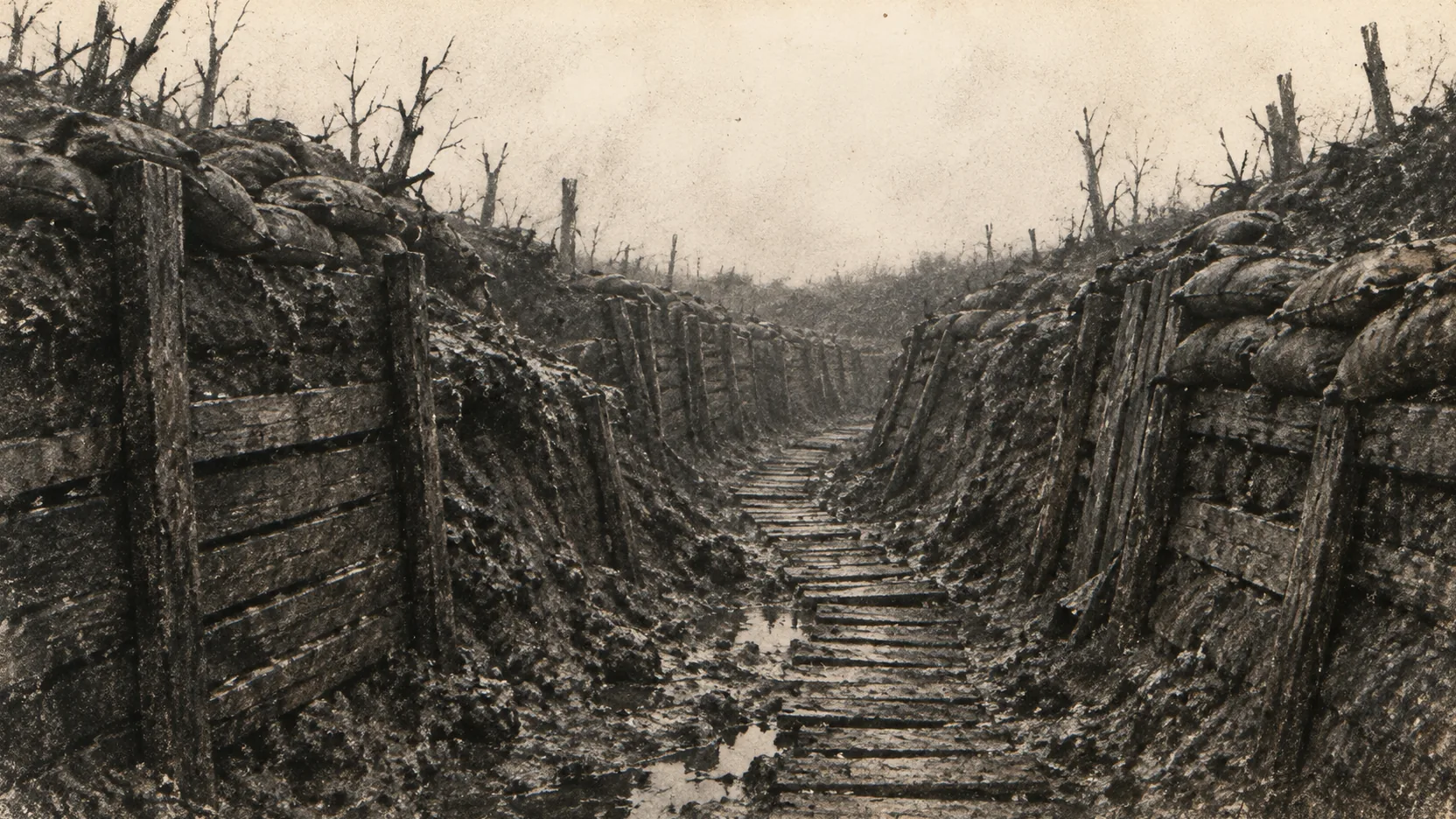
World War I was the first industrial war with an enormous loss of people and material. At the outbreak of the war none of the parties involved had expected such a long-lasting bloody conflict, but the military confrontation quickly developed—especially on the Western Front—into a stalemate and ultimately into a war of attrition. In this context, the opposing losses on both sides were even a relevant strategic calculation: it was assumed that the enemy would be exhausted both materially and morally, and hopes were placed on a breakthrough at the deadlocked front because the enemy would no longer have reserves to close the breach or gap in time. In this regard, targets were even set for how many losses through wounds and captivity (monthly) would be required to achieve the desired degree of enemy exhaustion (Ferguson, The Wrong War, p. 281).

Kriegsgeschichte
Scenes of War - German Soldiers in Palestine.
Work in progress.

Kriegsgeschichte
Scenes of War - German Tanks
Regarding the world's first tank battle, Thomas Weißbrich of the German Historical Museum (Berlin) reports the following: "It took place on April 24, 1918, between three British Mark IVs and three German A7Vs at Villers-Bretonneux. During the course of the fight two British and one German tank were damaged and put out of action. Although the German infantry managed to take the contested location, Australian troops recaptured it shortly thereafter."

Kriegsgeschichte
Scenes of War - Doctors, Stretcher-Bearers, Medics and Military Hospitals
In World War I a total of 8,388,448 wounded were recorded on the side of the Central Powers, of which 4,216,058 were German (according to another source: 5,686,937).

Kriegsgeschichte
Scenes of War - Railways and Transport
In the occupied territories the German railway had 24,000 km of standard-gauge and 4,000 km of narrow-gauge track. Between 8,000 and 9,000 locomotives and approximately 18,000 railway wagons were available. The railway formations included about 178,000 persons in 1918, among them 75,000 civilian railway employees. Prisoners and inhabitants of the rear-area regions were employed for the extensive construction work. By mid-1918 there were on the various German theaters of war 7,760 standard-gauge and 940 narrow-gauge locomotives; the number of available railway wagons is reported as approximately 180,000.

Kriegsgeschichte
The Course of the First World War (1918)
The beginning of 1918 was marked by peace efforts, in particular the message of American President Wilson which set out a peace program of 14 points. In Austria and Germany mass strikes alarmed the political and military leadership. The American peace initiative was commented on in varying ways on the German side, but ultimately found no positive echo among the Central Powers. At that time the Allied side was also not really willing to negotiate. Between late October and mid-February peace negotiations between Russia and the Central Powers took place in Brest-Litovsk. The peace terms offered were harsh. The Russian negotiator Trotsky announced the demobilization of the Russian army but did not want to accept the conditions set by the Germans. Thereupon military hostilities flared up again and German troops advanced further into Russian territory. In February Reval, Minsk and Zhytomyr and in March Kiev were occupied. On 03.03. a formal peace was concluded after all, since the Russian empire, destabilized by the revolution, urgently needed peace. Already on 09.02. a peace had been concluded with Ukraine. This freed Germany from a two-front war and allowed it to reinforce the Western Front with troops no longer needed in the East, yet the presence of the Central Powers in the politically restless eastern regions was still required as a protecting power.

Kriegsgeschichte
Scenes of War - Rail Transport
The railway played a decisive role in the First World War. Without the developed rail network the rapid mobilization of the (seven) German armies in the West would not have been possible. But a powerful rail system was also indispensable for rapid troop movements. Already in the run-up to the Franco-Prussian War of 1870/71 the German General Staff had recognized the decisive importance of the railway. In 1914 there were already15 bridges over the Rhine between Strasbourg and Wesel. In addition to the classic rail network, branch lines or light railways also assumed an important role during the course of the war, especially in the front area. To do justice to the strategic role of the railway, at the beginning of the war the various railway administrations were merged and placed under a central military command.

Kriegsgeschichte
Scenes of War - Rear Area
The rear area was the link between the front and the homeland. Without a well-functioning rear area the front was not effective.

Kriegsgeschichte
The Course of the First World War (1916)
On 04.01.1916 the OHL decided to attack Verdun. The intention was not a breakthrough battle, but limited German forces were to fix strong enemy troops at this prestigious point of the Western Front and thus sustainably weaken the enemy through heavy losses. On 21.02. the Army of the German Crown Prince began the attack and achieved initial successes. Thus Fort Douaumont could already be captured on 25.02., the village of Douaumont on 02.03. and the village of Vaux on 08.03. On 14.03. the height known as “Toter Mann” was stormed.

Kriegsgeschichte
The Course of the First World War (1917)
On 19.01. a German alliance offer was made to Mexico. This inevitably led to tensions with North America. On 01.02. Germany announced unrestricted submarine warfare. The demand for such a massive trade war also came from ranks of the Reichstag and put Chancellor Bethmann Hollweg under pressure.

Kriegsgeschichte
The Course of the First World War (1915)
On 16 February 1915 the French High Command ordered a renewal of the offensive in the Champagne. For the first time, hours of artillery fire prepared the infantry attacks, which nevertheless failed against the strong defensive power of the German positions. The French lost about 240,000 men, the Germans only 45,000. The British offensive at Artois beginning on 10 March also failed. The Germans remained on the defensive in the West and concentrated on further expanding their positions. Up to then these had lacked tactical depth; a second and third line were now created. It remained problematic that on both sides each main battle line was absolutely to be held in the event of enemy attacks. This rigid doctrine led to senseless losses; only slowly did the leading military commanders realize that both the classical form of attack and an overly rigid defensive posture did not lead to success or led to unacceptable losses.

Kriegsgeschichte
The Course of the First World War (1914)
From August 2, 1914 the VIII German Army Corps occupied Luxembourg. On August 3/4 German troops crossed the Belgian border. Liège was shelled and captured. Following the defeats of the small Belgian army, German victories over the French in Lorraine followed in the second half of August. Namur was captured. The French withdrew because of the German offensive; the British Expeditionary Force was defeated at Mons (August 23/24) and fell back to the Channel coast. This was followed by the Battle of the Meuse (August 24–29). Longwy and Montmédy were captured by the Germans, and on September 5, 1914 the 3rd German Army crossed the Marne.