
The Course of the First World War (1916)
The War Year 1916
On 04.01.1916 the OHL decided to attack Verdun. The intention was not a breakthrough battle, but limited German forces were to fix strong enemy troops at this prestigious point of the Western Front and thus sustainably weaken the enemy through heavy losses. On 21.02. the Army of the German Crown Prince began the attack and achieved initial successes. Thus Fort Douaumont could already be captured on 25.02., the village of Douaumont on 02.03. and the village of Vaux on 08.03. On 14.03. the height known as “Toter Mann” was stormed.


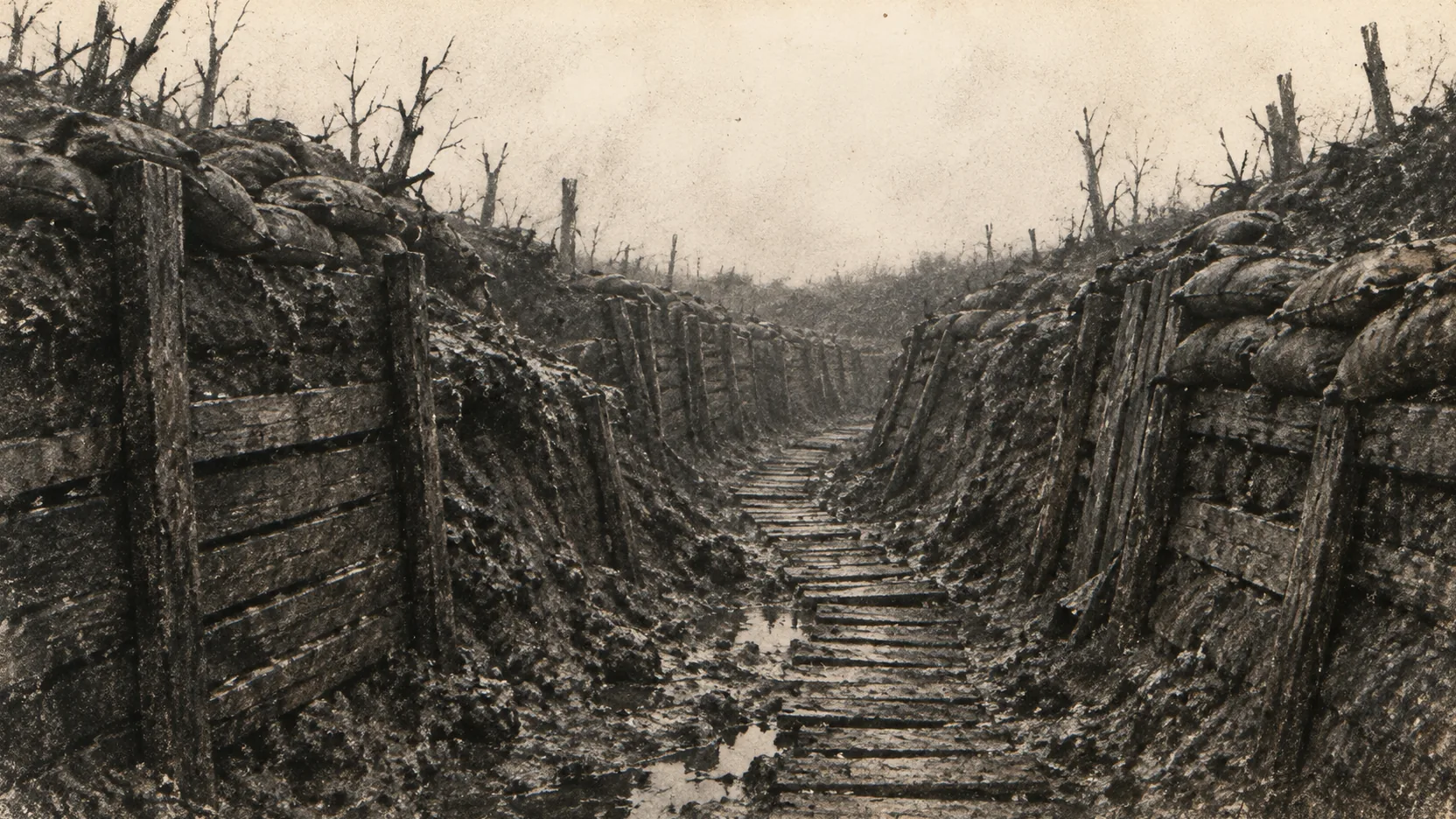
The German High Command’s goal of bleeding the French army white did not materialize, however, because fighting on both sides incurred enormous losses. The hopeless offensive was therefore halted in September. As early as 25.06. British (and French) forces—also to relieve the French troops—had begun a breakthrough battle in the sector around Verdun in the area of the Ancre and the Somme. After several days of heavy artillery bombardment and months of fighting, the German front could be pushed back on a width of about 40 km and a depth of 12 km, but a breakthrough was not achieved—despite the clear material superiority of the British and French. The battles around Verdun and the Battle of the Somme had again shown that the defender was regularly in the stronger position. A return to maneuver warfare was not achieved despite the enormous commitment of materiel and mass attacks. The losses—750,000 dead on both sides in the Battle of the Somme alone—do not justify the minor corrections of the front line. In the materiel battles the soldiers involved reached the limits of psychological endurance. The special demands of the materiel battle created a new type of soldier; a community of necessity formed in the trench beyond hierarchical and class differences. The gulf between the units deployed at the front and the rear area grew increasingly wider.


While, from the viewpoint of the Entente and the Central Powers, the decision was to be made on the Western Front, the Italians attempted the breakthrough in the Alps. The first five Battles of the Isonzo (most recently: 15–20.03.) had brought only slight territorial gains. The next four battles in August (04–16), September (14–17) and October (09–12, 29–31) developed into mutual wars of attrition with heavy losses for both sides.

In the east the Central Powers were surprised by large-scale Russian attacks. In the course of the so-called Brusilov Offensive (04.06. – 07.12.) the Russians achieved enormous breaches in the southern Eastern Front and inflicted a significant defeat on the Austrian troops. The Central Powers, heavily engaged due to the fierce fighting on the Western Front and in the Alps, had to react, and only the German counterattacks under General von Linsingen brought the successful Russian offensive to a halt.
While, from the viewpoint of the Entente and the Central Powers, the decision was to be made on the Western Front, the Italians attempted the breakthrough in the Alps. The first five Battles of the Isonzo (most recently: 15–20.03.) had brought only slight territorial gains. The next four battles in August (04–16), September (14–17) and October (09–12, 29–31) developed into mutual wars of attrition with heavy losses for both sides. In the east the Central Powers were surprised by large-scale Russian attacks. In the course of the so-called Brusilov Offensive (04.06. – 07.12.) the Russians achieved enormous breaches in the southern Eastern Front and inflicted a significant defeat on the Austrian troops. The Central Powers, heavily engaged due to the fierce fighting on the Western Front and in the Alps, had to react, and only the German counterattacks under General von Linsingen brought the successful Russian offensive to a halt.

On 27.08. Italy declared war on Germany; in August Romania entered the war on the side of the Entente due to its close ties with Russia. This was followed by an attack by the Central Powers on Romania, supported from the beginning of September (01.09.) by Bulgaria. By March 1916 Macedonia had already been occupied by the Central Powers, and in January and February the Austrians had invaded Albania. Under the supreme command of Field Marshal von Mackensen, German, Austrian, Bulgarian and Turkish troops went on the offensive against Romania and were able to defeat the Romanian army except for remnants. The latter retreated toward the Russian front.


In the course of the Balkan campaign the newly formed German 9th Army under General von Falkenhayn had completely driven the Romanians out of Transylvania. After the unsuccessful offensive at Verdun Falkenhayn had to hand over supreme command on 29.08. to the successful leadership duo Hindenburg/Ludendorff. Hindenburg became Chief of the General Staff and Ludendorff assumed the position of First Quartermaster General. Falkenhayn’s attrition strategy had failed in the west; however, he was given the chance for rehabilitation in the Balkans.

From February/March the campaign against merchant shipping was continued by German U-boats, although the naval war was still supposed to be conducted in a restricted manner. Only armed auxiliary cruisers had so far continued the commerce war—even overseas. From 31.05. – 01.06. the largest sea battle of organized fleets took place in the Skagerrak between the British fleet under Admiral Jellicoe and the German fleet under Admirals Hipper and Scheer.

The battle exchange—at least unintentionally from the German side—between the German High Seas Fleet and the Royal Navy ended with lower losses for the German ships; about 6,000 British and about 2,500 Germans lost their lives. The British commander Jellicoe had several opportunities to force a decisive outcome, but through skillful actions the German fleet removed itself from destruction in time. Ultimately the fight between 151 English and 99 German ships ended with a tactical success for the German High Seas Fleet, whose crews and ships proved themselves. The battle did not have decisive significance. The British Admiral Jellicoe was replaced in November by Admiral Beatty.


Overseas, on 18.02. the remnants of the German colonial troops in Kamerun laid down their arms.
Over the course of 1916 the impact of the war on the internal conditions of the belligerent states became increasingly apparent. All states had to pay tribute to the necessities of war. The Entente’s material superiority was already felt oppressively in the Battle of the Somme; in Germany, due to lacking imports, initial supply and food problems became visible (the turnip winter of 1916/17). Food rationing had already been introduced as early as 1915. Economic life had to be increasingly regulated by the state and the use of raw materials organized. Shortages forced procurement of substitutes. Military leadership gained increasing influence over foreign and domestic policy; central offices for the administration of all raw materials were created and the entire economy was oriented to the needs of the war. Free trade was replaced by a kind of command economy; the state coercive measures of the so‑called Hindenburg Program affected almost all economic and social sectors. In May there were first hunger demonstrations in Leipzig. On 02.12. a law on the Patriotic Auxiliary Service was adopted. This militarized large parts of the economy for the purposes of armaments production. Workers could now be conscripted. The war aims of the Central Powers prevented realistic peace efforts; a separate peace with Russia did (not yet) materialize.
The year 1916 brought a deep political crisis for Germany. The enormous number of the fallen and the difficult food situation led to domestic tensions. The great prestige of Hindenburg and Ludendorff was supposed to bring about a military turning point, but after three years of war there were a number of peace initiatives. In December 1916 the American President Wilson presented a plan of 14 points for ending the war to all belligerent states. Already on 12.12.1916, after the victory over Romania, there had been a peace offer from the four Central Powers to the Allies. They wanted to come to terms from a position of strength, but the Entente’s answer was unequivocally negative. The American peace initiative also failed. On 04 and 07.01. the Allies decided in Rome to better coordinate future operations. Since an end to the war according to Germany’s ideas could obviously not be achieved at this time, a military decision was to be sought once more.

Recommended Articles

Organisation
The German Imperial Army in the World War - Structure, Organization and Uniforming of the Infantry - Reserve Infantry Regiments
In 1914 the German infantry comprised 217 regiments.

Kriegsgeschichte
The Course of the First World War (1917)
On 19.01. a German alliance offer was made to Mexico. This inevitably led to tensions with North America. On 01.02. Germany announced unrestricted submarine warfare. The demand for such a massive trade war also came from ranks of the Reichstag and put Chancellor Bethmann Hollweg under pressure.

Kriegsgeschichte
Scenes of the War - abandoned or destroyed British tanks
The British tanks were various models, called Mark I-V. These tanks measured 8 m in length and weighed 28 t. With 150 hp they reached a maximum speed of 7.4 km/h.