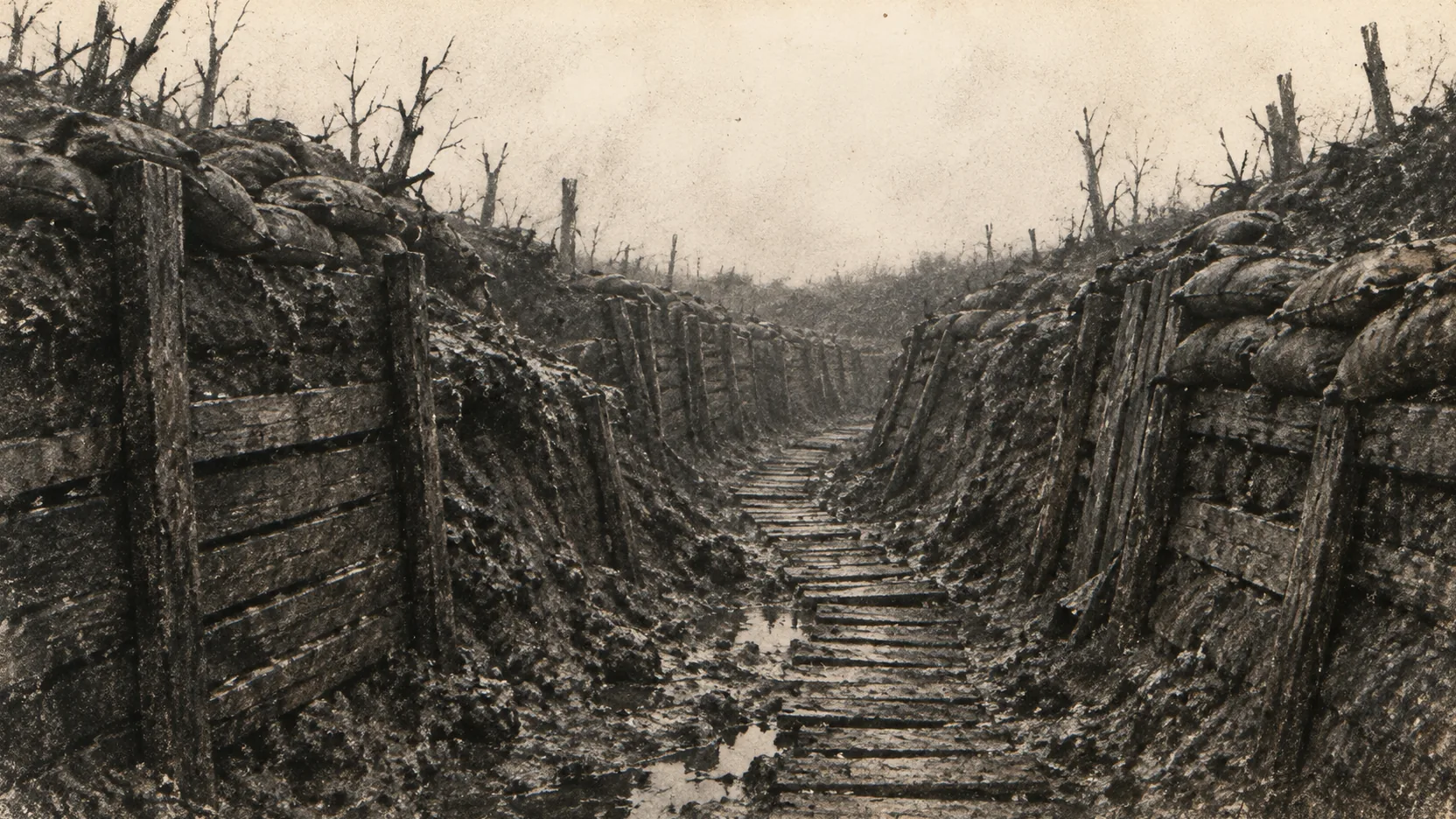

Scenes of War - Crater Landscape

For years, both the Central Powers and the Allies tried to break the stalemated fronts by an ever-increasing use of artillery and the corresponding consumption of ammunition. As a result, gigantic battles of materiel shaped conditions especially on the Western Front, while on the Eastern Front certain elements of maneuver warfare persisted.


The enormous use of materiel, for example by the Germans at Verdun (from February 1916) or the British at the Somme (from June 1916), was not justified by the respective territorial results; however, the guns dominated the battlefield and the barrage turned the fronts into eerie cratered landscapes.


It took many years (and enormous losses), for example, before the German military leadership realized that this method of fighting usually cost the attacker more than the defender. After the replacement of Lieutenant General v. Falkenhayn, the Germans therefore took new paths under Field Marshal von Hindenburg and General Erich Ludendorf in the last major offensive (Operation Michael) from March 1918 in Flanders; however, by then it was too late given the Allies' clear material superiority.

Recommended Articles

Kriegsgeschichte
The Course of the First World War (1915)
On 16 February 1915 the French High Command ordered a renewal of the offensive in the Champagne. For the first time, hours of artillery fire prepared the infantry attacks, which nevertheless failed against the strong defensive power of the German positions. The French lost about 240,000 men, the Germans only 45,000. The British offensive at Artois beginning on 10 March also failed. The Germans remained on the defensive in the West and concentrated on further expanding their positions. Up to then these had lacked tactical depth; a second and third line were now created. It remained problematic that on both sides each main battle line was absolutely to be held in the event of enemy attacks. This rigid doctrine led to senseless losses; only slowly did the leading military commanders realize that both the classical form of attack and an overly rigid defensive posture did not lead to success or led to unacceptable losses.

Organisation
The German Imperial Army in the World War - Structure and Organization - Airshipmen
Airshipmen on the Western Front. Original photo from the year 1916. Photographer: G. Gramsch/Dresden.

Kriegsgeschichte
Scenes of War - Rear Area
The rear area was the link between the front and the homeland. Without a well-functioning rear area the front was not effective.