
Scenes of War - Fallen

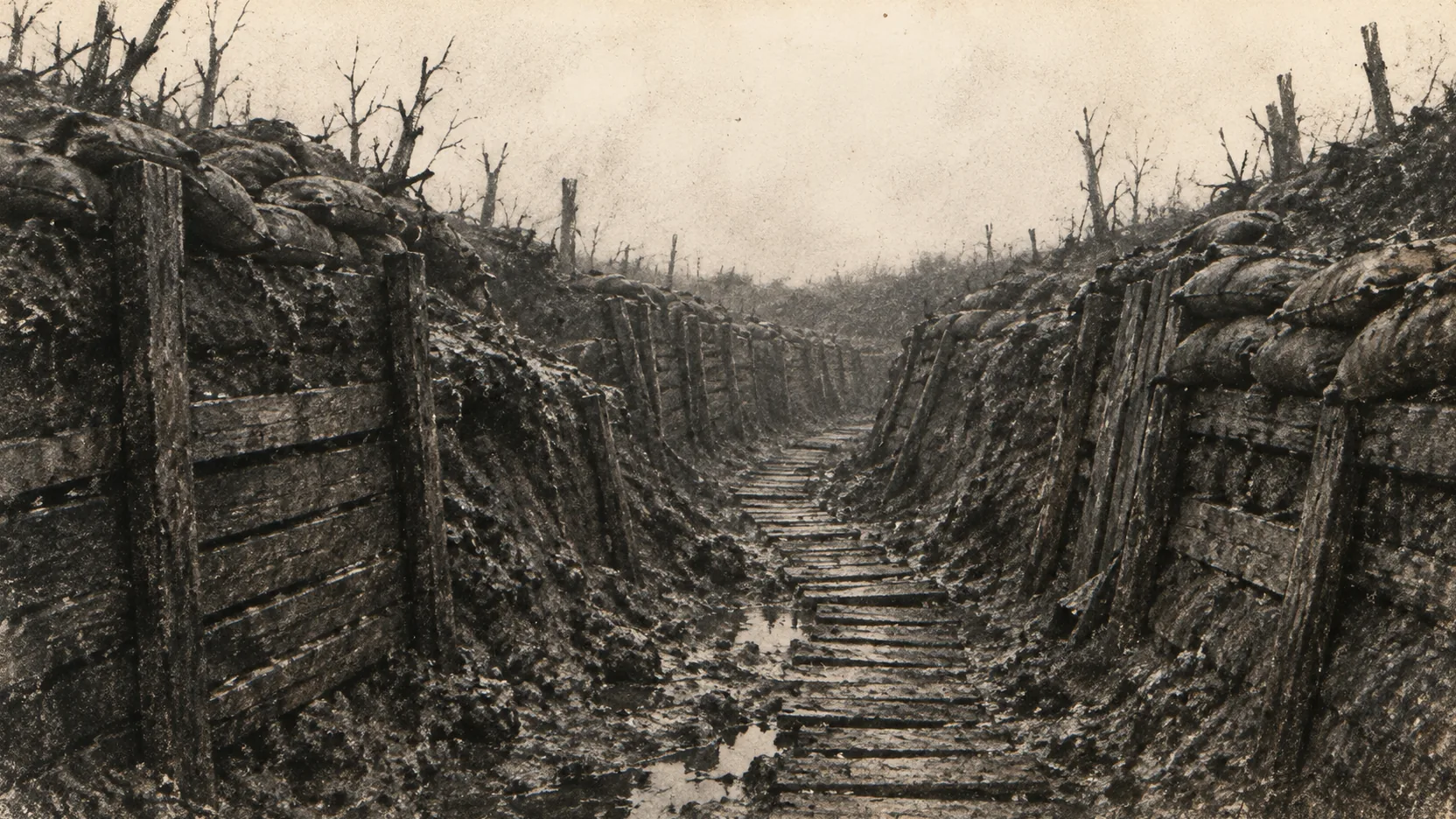
World War I was the first industrial war with an enormous loss of people and material. At the outbreak of the war none of the parties involved had expected such a long-lasting bloody conflict, but the military confrontation quickly developed—especially on the Western Front—into a stalemate and ultimately into a war of attrition. In this context, the opposing losses on both sides were even a relevant strategic calculation: it was assumed that the enemy would be exhausted both materially and morally, and hopes were placed on a breakthrough at the deadlocked front because the enemy would no longer have reserves to close the breach or gap in time. In this regard, targets were even set for how many losses through wounds and captivity (monthly) would be required to achieve the desired degree of enemy exhaustion (Ferguson, The Wrong War, p. 281).

In total, the Central Powers mobilized 22,850,000 soldiers in World War I, of whom 8,538,315 were killed or died.
Overall, World War I nearly cost the lives of 17 million people.

Germany suffered 1,773,700 dead (according to other sources: 2,000,876 or 2,037,000).
On the German side, a total of 1 3677 600 participants in the war (approx. 24% of the population) is assumed. With an assumed loss of 2,000,876 dead, this would be a share of 14.9%.
German losses are distributed as follows: field/occupation army 1,900,876; navy 34,836; in the colonies 1,185. In addition there are about 100,000 missing who were considered dead (figures according to Stachelbeck, Germany's Army and Navy in the First World War, p. 157, based on the medical report of the German Army).

Of the roughly 281,000 officers of the German army, about 55,000 fell (= 19%). The losses among the ranks – including non-commissioned officers – are estimated at about 14%.
About 1,250,000 dead German soldiers were buried outside the homeland, among them 1,053 German Schutztruppen in the colonies.

Funerals


Turning to the losses of individual regiments in this context, almost unfathomable numbers of bloody losses are to be noted. For example, the Lehr Infantry Regiment lost a total of 5,600 men – including the missing. For the 5th East Prussian Infantry Regiment No. 41 (Tilsit/Memel) total losses in World War I are given as 6,815 men. Comparable are the losses of the 2nd East Prussian Grenadier Regiment No. 3 (Königsberg in Prussia) with 5,730 men and the 6th East Prussian Infantry Regiment 43 (Königsberg in Prussia/Pillau) with 6,072 men (figures according to Martin Lezius, in: Zeitschrift für Heereskunde, 1931, No. 29, p. 253). These are the infantry regiments with the highest losses, but the losses of other formations are hardly less. For example, the 1st Westphalian Infantry Regiment (Münster) recorded a total loss of 175 officers and 4,038 non-commissioned officers and enlisted men. The number of soldiers who were "only" wounded is not included here.
Graves


The massive attacks in trench warfare also brought heavy losses to the Entente despite regularly extensive preparation by barrage fire, whereby the losses of the attacker were in principle potentially higher than those of the defender. On the first day of the Battle of the Somme, for example, the British army lost 60,000 men, whereas the German defenders lost "only" 8,000 men. Overall in this battle British losses amounted to 419,654 men, the French lost 204,253 men. These figures were contrasted by German losses of approximately 680,000 men. The hope of bleeding the enemy dry thus apparently did not pay off.

The figures for the losses in the war of attrition at Verdun vary. According to the records of the Supreme Army Command, German losses (= killed, wounded and missing) amounted to 336,831 and French losses to 362,000 men. The German medical report speaks of 350,000 German losses. For the period from 21.02. to 10.09.1916 German casualties in the Battle of Verdun are given as 54,929 killed and 26,739 men (figures according to Harald R. Henn, the "Hell of Verdun", in: Damals, issue 4/April 1977, p. 326). In the so-called Nivelle Offensive in April 1917 French losses amounted to 187,000 men, German losses are given as 163,000 men. Despite minor territorial gains in the Battle of Arras in April and May of that year, the British suffered a total of 159,000 men in losses within 39 days. Such losses could hardly be replaced. The sad tally of the Third Battle of Ypres was about 250,000 men on each side.

The ultimately unsuccessful German offensive in 1918 (Operation Michael) led to German losses of 250,000 men, the British lost 178,000 men and the French 77,000 men. By the end of April 1918 the losses had already risen to 348,000 men, 24,000 men and 92,000 men respectively (figures according to Ferguson, The False War, p. 281 ff.).

The Italian army entered the First World War in 1914 and attempted to detach or "liberate" certain provinces from the Austrian state. The so-called Isonzo battles, however, did not bring the hoped-for territorial gains. Only in the eleventh battle were there some successes. By that time the Italians had already lost 1 million soldiers. In 1917 the breakthrough of the German-Austrian 14th Army at Flitsch and Tolmein then occurred. Within 14 days the Italians not only lost the territories they had previously captured, but also 4,000 killed, 265,000 prisoners, and 3,000 guns.

Cemeteries


Recommended Articles

Kriegsgeschichte
Scenes of War - Rear Area
The rear area was the link between the front and the homeland. Without a well-functioning rear area the front was not effective.

Kriegsgeschichte
Scenes of War - German Tanks
Regarding the world's first tank battle, Thomas Weißbrich of the German Historical Museum (Berlin) reports the following: "It took place on April 24, 1918, between three British Mark IVs and three German A7Vs at Villers-Bretonneux. During the course of the fight two British and one German tank were damaged and put out of action. Although the German infantry managed to take the contested location, Australian troops recaptured it shortly thereafter."

Kriegsgeschichte
Scenes of War - German Soldiers in Palestine.
Work in progress.