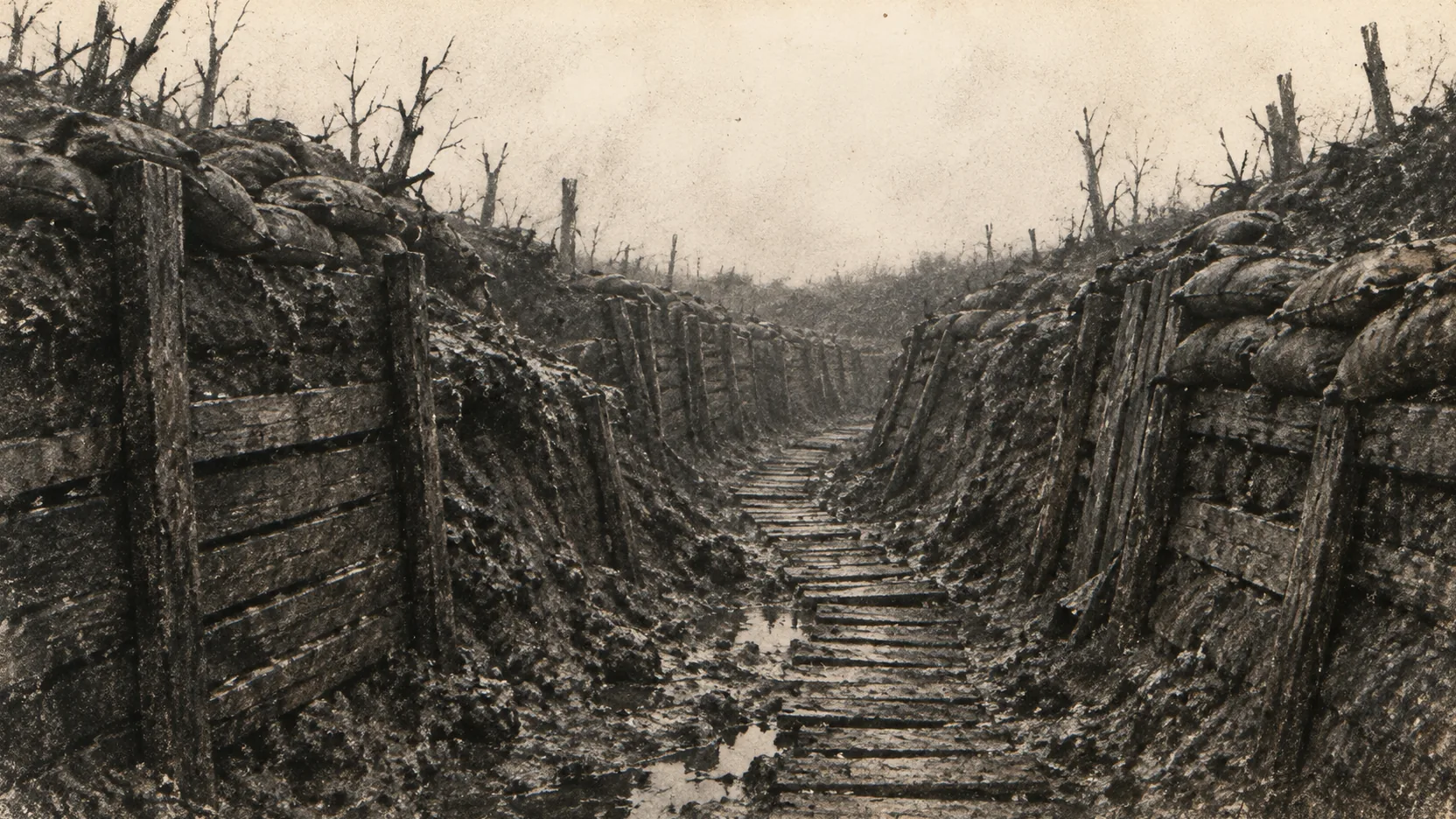

Scenes of War - Doctors, Stretcher-Bearers, Medics and Military Hospitals
In World War I a total of 8,388,448 wounded were recorded on the side of the Central Powers, of which 4,216,058 were German (according to another source: 5,686,937).
From the beginning of the war until the end of 1914 there were already 540,718 wounded, including 11,519 officers.
On average the German army suffered about 34.5 per thousand losses annually in 1914–18.
Of 100 wounded, 81 left the hospital cured; about more than half (54) returned to the front.
Most fatal injuries were caused by artillery effects.
About 70,000 gas casualties were treated in the hospitals, of whom about 8% died.

The medical personnel of the German army before the world war consisted of medical squads, stretcher-bearers, military orderlies, as well as medical officers, medical officer candidates, military pharmacists and hospital administrative officials.
The former were attached to the individual formations and were drawn from the ranks. The stretcher-bearers and military orderlies belonged to the train.
In peacetime stretcher-bearers only existed for exercises and maneuvers (they already existed in 1813).
Medical officers were licensed physicians with various ranks.
Military pharmacists and hospital administrative officials belonged to the military administration.


Medical squads had been considered combatants since 1867; from 1869 the Red Cross armband on the left upper sleeve was mandatory for them. It was probably worn for the first time in the 1866 campaign.
Orderlies traditionally wore an entirely blue uniform.


From 1913 onwards the medical squads, however, wore the uniform of their unit (with a yellow Rod of Asclepius on the right upper arm).

In the First World War the head of the medical service of the German army at the so-called Great Headquarters was the Chief of Field Medical Services.
According to Cron, the O.H.L. had 11 hospital and 7 auxiliary hospital trains at its disposal.
At each army high command there was the army surgeon and at each lines inspection the lines surgeon. He was assisted by an advisory hygienist.
There were also casualty transport units, medical depots, etc.
Each general command had a corps surgeon.
Medics


On the organization of the medical service at the front and in the rear, the author (Schulz) states the following in his regimental history of Infantry Regiment Graf Bülow von Dennewitz (No. 55) in the World War (Detmold 1928):
"The medical service in the trench can be divided into two groups: the service in the local sick wards of the rest billets and the service in the front line. In the rest billets the battalions set up local sick wards. The lightly ill, who would recover quickly and for whom evacuation to hospitals and home was not necessary, were sent there. The service in the local sick ward took place in a similar manner to the regimental medical service and the stay in the regimental sick ward back home. Each company kept a troop sick book of all members of its strength who received medical treatment.
In addition, medical shelters were set up near the battalion combat positions in the line. These were the troop dressing stations. All wounded were brought there and received their first medical treatment. It was decided there whether the wounded should be sent to the hospitals or returned to the local sick wards. That depended on the degree of their wounds.
Furthermore, all preparations for a larger initial intake of wounded during combat actions were made in the medical shelters.
The regimental surgeon determined which medical officers would go with the battalions into the line and which would perform duty in the regimental sick wards. In the same way the battalion surgeons assigned the medical non-commissioned officers, corporals and men to their service.
A valuable supplement to the medical subordinate personnel were the four stretcher-bearers of each company available to the battalion. They were also mainly used in the troop medical service. By order of the battalion surgeons they were alternately employed for medical service in the line and for duty in the local sick wards.
Musicians and assistant musicians could also be used as auxiliary stretcher-bearers. This authorization was used for the first time at Maubeuge. There the musicians, apart from the five oldest oboists who had to safeguard the musical instruments, and one assistant oboist who drove the requisitioned wagon with the instruments, were distributed to the battalions as auxiliary stretcher-bearers. Thus they too stood in the fire and carried many wounded from the fire to the rear. Before Reims, Sergeant and oboist Lann was severely wounded in this service.
At Loretto Heights the brave and universally esteemed music director Hubert also volunteered as an auxiliary stretcher-bearer. His request was approved. From then on he went into the line to recover wounded and fallen and received the Iron Cross 2nd Class in recognition of the services rendered as an auxiliary stretcher-bearer under enemy fire.
Already in November 1914 part of the musicians were withdrawn from service as auxiliary stretcher-bearers. After the May battles of 1915 the last oboists were returned to the music corps so that it was once again complete. Later the music corps was only used for stretcher-bearer duties upon special order in cases of heavy losses, for example in September 1916 at the Somme. It only suffered one death, due to illness. Four oboists were wounded" (p. 127).


Individual corps had 12 field hospitals; reserve corps had fewer. Each division had a divisional surgeon with 1–2 medical companies. The troop units also had doctors, medical soldiers and auxiliary stretcher-bearers. From 1916 each division included one medical company and 2 field hospitals. From April, stage medical motor vehicle units were formed – partly from captured vehicles. These were later renamed and became army troops.

Hospitals were (and are) institutions for the inpatient care of wounded soldiers. In the theater of operations a distinction was made between field and war hospitals, sometimes with surgical departments. In the rear there were also hospitals and finally reserve, association and home hospitals in the homeland. Near the front hospitals were set up for lighter cases to allow a quicker reintegration of the soldier after recovery and to avoid unnecessarily weakening the front-line troops for too long.


As soon as it was possible, the wounded were transported further to the rear, the more severely wounded by hospital trains to the homeland. There were 258 of these, which together made about 25,000 journeys. A total of 34,000 beds were available on the hospital trains. 89 of the trains belonged to voluntary nursing services.


Red Cross nurses were also employed in the hospitals. They were mainly used for the care of the wounded at home, but also behind the front. At the outbreak of war fully trained nurses (6,000), auxiliary nurses (1,000) and helpers (7,000) were available. As early as 1869 the Bavarian Women’s Association of the Red Cross had been founded. Similar associations also arose elsewhere, e.g. the auxiliary nurses association in Berlin founded in 1875 by Countess Hedwig Rittberg.
Red Cross Nurses


Recommended Articles

Kriegsgeschichte
Scenes of War - Tethered Balloon
The use of balloons on the battlefield was already practiced during the Revolutionary Wars.

Kriegsgeschichte
Scenes of War - Trench Warfare - Firing pits and trenches.
Whereas a firing pit generally served only one, or at most two, soldiers to protect against enemy action, a trench was a massive form of a sunken field fortification with a firing passage amid forward and rear cover to enable secure firing and protection against bombardment, e.g. by shells.

Kriegsgeschichte
Scenes of the War - abandoned or destroyed British tanks
The British tanks were various models, called Mark I-V. These tanks measured 8 m in length and weighed 28 t. With 150 hp they reached a maximum speed of 7.4 km/h.