
Scenes of War - Soldiers and Guns


At the beginning of the war artillery was still regarded as an auxiliary weapon, but developments quickly showed that this was an outdated tactical approach.
The vast majority of European militaries still considered infantry the main weapon, whereas the role of cavalry was controversial.

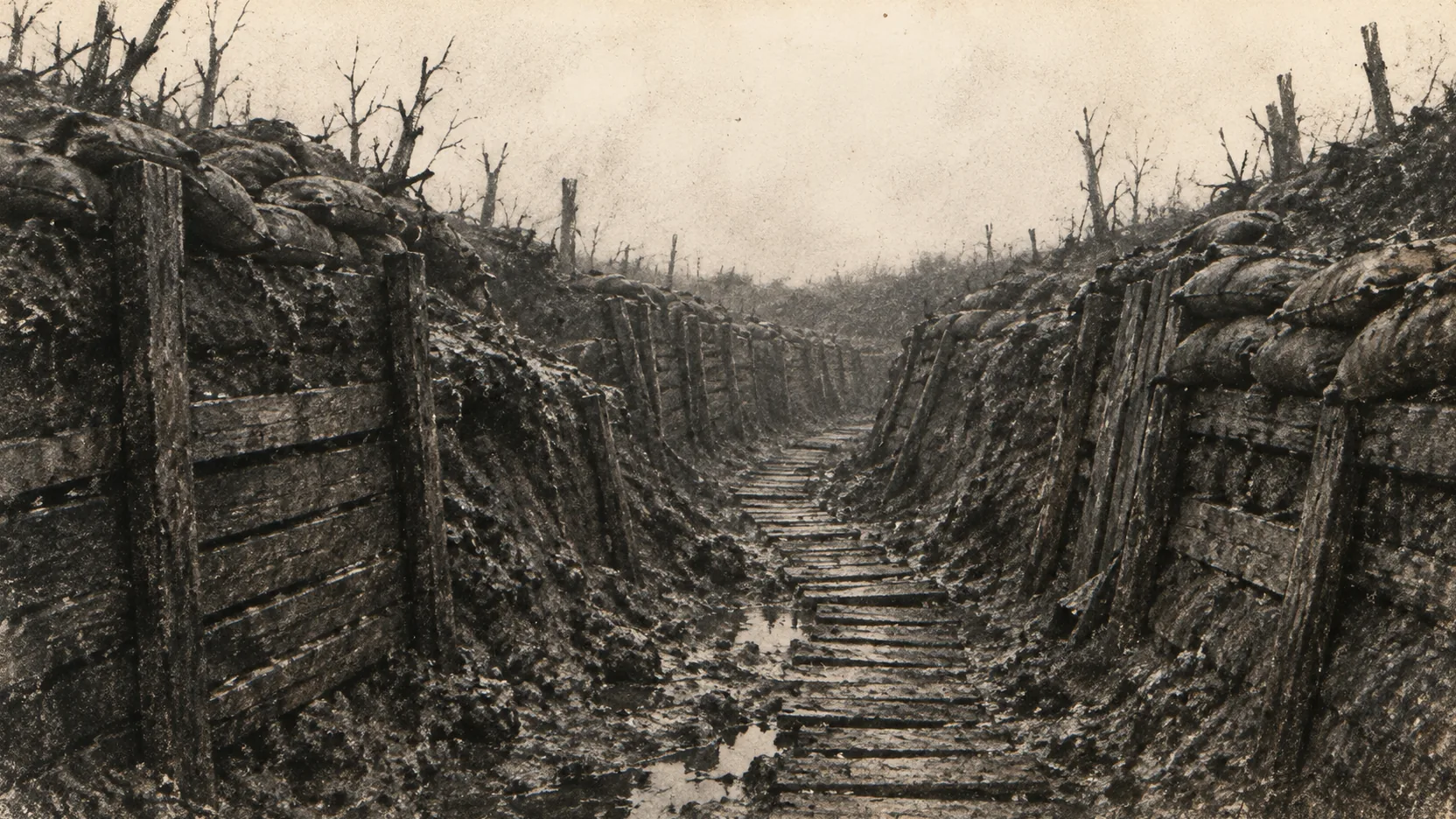
With the onset of trench warfare, everyday life at the front rather resembled the conditions of a fortress war, and technical weapons consequently moved to the center of events.

Hans von Gottberg (Männer, Waffen, Strategen. Das große Buch der Soldaten, Stuttgart 1981, pp. 142 ff) writes: "The gun equipment of the artillery was likewise unrecognizable. The divisional artillery regiments (so-called foot and field artillery) possessed the light field howitzer FH 16 (caliber 10.5 cm, range 9,100 meters) and the field gun 96/16 (caliber 7.5 cm / range 11,900 meters). In addition the heavy field howitzers sFH 13 (caliber 15 cm, range 8,500 meters) belonged to the divisional artillery as well as the 10.5 cm guns K 17/04 and the 15 cm guns. The regiments of the army artillery were equipped with 12 cm mortars, 18 cm howitzers and long-barreled gun batteries. To the army artillery also belonged the huge 42 cm mortars L/12, known as "Dicke Berta". Their high-angle shells, fired at 9,300 Mter and weighing almost 1,000 kilograms, penetrated 1.5-meter-thick concrete vaults, the armored turrets of the Belgian barrier forts of Liège and Namur....".


"... In addition there was the long-range railway artillery. These were heavy long-barreled naval guns mounted on special railway platform wagons. The calibers were 24, 28, 30.5 and 38 cm...".


"... The latter gun, the so-called 'Lange Max', which fired 18-centner heavy shells over 128 kilometers into the French capital, were 21 cm railway-bed long-barreled guns. The barrel length was 34 meters. The projectile reached a height of 40 km when fired to 128 kilometers!".

The monthly production of heavy guns for the German army in 1917 averaged 400; for the field artillery 3,000 guns were produced monthly in that year.

However, due to shortages of raw materials these figures fell sharply in 1918. In that year the German army possessed almost 18,000 guns on all fronts.
These numbers demonstrate the outstanding importance of artillery in the World War.

"Very instructive is the comparison of the inventory of heavy artillery at the beginning of the war and towards the end: At the beginning of the war 48 regiments (25 active and 23 reserve with 105 battalions (382 batteries); 2 Saxon reserve battalions with 8 batteries; 24 Landwehr battalions with 96 batteries; 5 heavy coastal-mortar batteries, 3 short naval-gun batteries; 22 Landsturm foot-artillery battalions and 48 extraordinary batteries for fortresses...".


"... Towards the end of the war there were 62 regiments with 190 battalions (570 batteries), 231 independent battalions (699 batteries), 7 short naval-gun batteries, 8 heavy coastal-mortar batteries, 5 heavy 15-centimeter gun batteries, 50 mobile Landsturm batteries.
In the battalions there were in part also very heavy long-range guns incorporated that belonged to the naval artillery. The number of mobile foot-artillery batteries in the field army amounted at the beginning of the war to 148, at the end to 1,575".
Otto Bleck et al., Das deutsche Wehrwesen in Vergangenheit und Gegenwart, Berlin 1935, p. 195.

In his regimental history of the Royal Prussian Field Artillery Regiment No. 92 the author (Freyer, Berlin 1930) comments on the development of artillery use in positional warfare as follows: "The nature of positional warfare required new measures. Gradually the planned firing formed, firing at registered points, the barrage, destruction and disruption fires. Lateral and elevation directions to all salient points were fixed and an extensive telephone network was expanded. In particular the barrage fire, which later was to play such an extraordinary role, was over time developed into a true art, especially after the introduction of the method to eliminate daytime influences" (p. 55).

In the aforementioned work the following remarks appear concerning ammunition and equipment in the course of the war: "The excellent ammunition that had been manufactured in peacetime for wartime needs was unfortunately already exhausted after the first months of the World War, as no one had reckoned with the consumption rapidly increasing to gigantic proportions. As industry was initially not sufficiently prepared to produce large quantities of ammunition, an improvised ammunition, a grey-cast-iron shell was produced around October 1914 - the so-called 'red ammunition'. This was unreliable, because the shells, due to the great difference in weight, had exceptionally large dispersions. The projectile effect was poor. A small consolation was that the French suffered from the same difficulties. Among their ammunition, to our great joy, there occurred an extraordinarily large number of duds. Also the ammunition captured in the Belgian fortresses and fired by us was often extremely defective....".

"... In the further course of the war our ammunition improved, particularly as long shells and sensitive fuzes reached the front. The nonetheless rather complicated shrapnel-burning-fuze firing had to give way more and more to the simpler impact firing. Already towards the end of 1914 the French were supplied from America with excellent steel shells with powerful bursting charges, which caused us many losses. Our guns were excellent despite increasing difficulties in raw material supply; they withstood tremendous strain. Guns from which over 10,000 rounds had already been fired still shot with commendable accuracy. Also the guns manufactured later in the war were of relatively high quality, even if they were produced more plainly and no longer bore the inscriptions familiar to the artilleryman: Pro gloria et patria - Ultima ratio regis" (p. 117).


On the preparations (artillery preparations) for the so-called Kaiserschlacht on 21 March 1918 Martin Middlebrook (The First Day on the Somme? No — different book but keeping reference as in source) (Der 21. März 1918. Die Kaiserschlacht, Frankfurt a. M. 1979, p. 82) reports: "On the way to the front I noticed the numerous well-camouflaged stacks of ammunition. Under every bush and in the open terrain lay ammunition of every caliber in large quantities. Still not a single gun was to be seen. Instead small yellow wooden pegs were stuck in the ground. There were hundreds. .... Two of them marked the gun wheels, and a larger stake behind them the trail. Every gun position had been precisely surveyed" (Lieutenant Kurt Fischer, 464th Infantry Regiment).

Paul Eittighofer describes the dramatic effects of the artillery battle for Fort Douaumont in May 1916 in his well-known book Verdun (Wiesbaden and Munich 1976, pp. 182 ff.): "The French artillery fires rapid-fire from all barrels and lays down a belt of barrage fire. The German artillery likewise fires from all barrels and lays down a belt of barrage fire. No one can distinguish which artillery is firing and which shells are raining down at this or that spot. It does not matter either, and in this chaos of titanic noise and will to annihilate it is entirely the same to the men who must endure the terrible that whether they are hit and torn apart by a German or a French shell. In them every thought and feeling has ceased. Flames dance on the coffin lid, the explosions of shells of all calibers from German and French barrels whirl up, fountains of dirt are hurled up. Hell around Verdun is back again in all its dreadfulness. It is a danse macabre to the point of madness. Under this bell of raging explosions, of the whine of splinters and hissing bullets, of machine-gun barking and human screams, the fighting men of both nations lie and act quite mechanically, and in their souls only now and then a thought flashes: "O mother, why did you give birth to me that I must witness such things?"

Recommended Articles

Organisation
The Development of the German Imperial Army in World War I (1914–18) - An Overview
At the outbreak of World War I the Imperial Army comprised 92½ infantry and 11 cavalry divisions with 5,124 field guns and 575 heavy guns.

Organisation
The German Imperial Army in the World War - Structure and Organization - Engineers
During the First World War the engineer arm experienced an unforeseen rise in importance and, as the daily reality of war increasingly resembled that of fortress warfare, became an important support arm for the infantry.

Uniformierung & Ausrüstung
The German Imperial Army in the World War - Uniforms and Equipment - Headgear - Steel Helmet
But the most conspicuous change was the introduction of the steel helmet in 1916, which replaced the classic Pickelhaube.