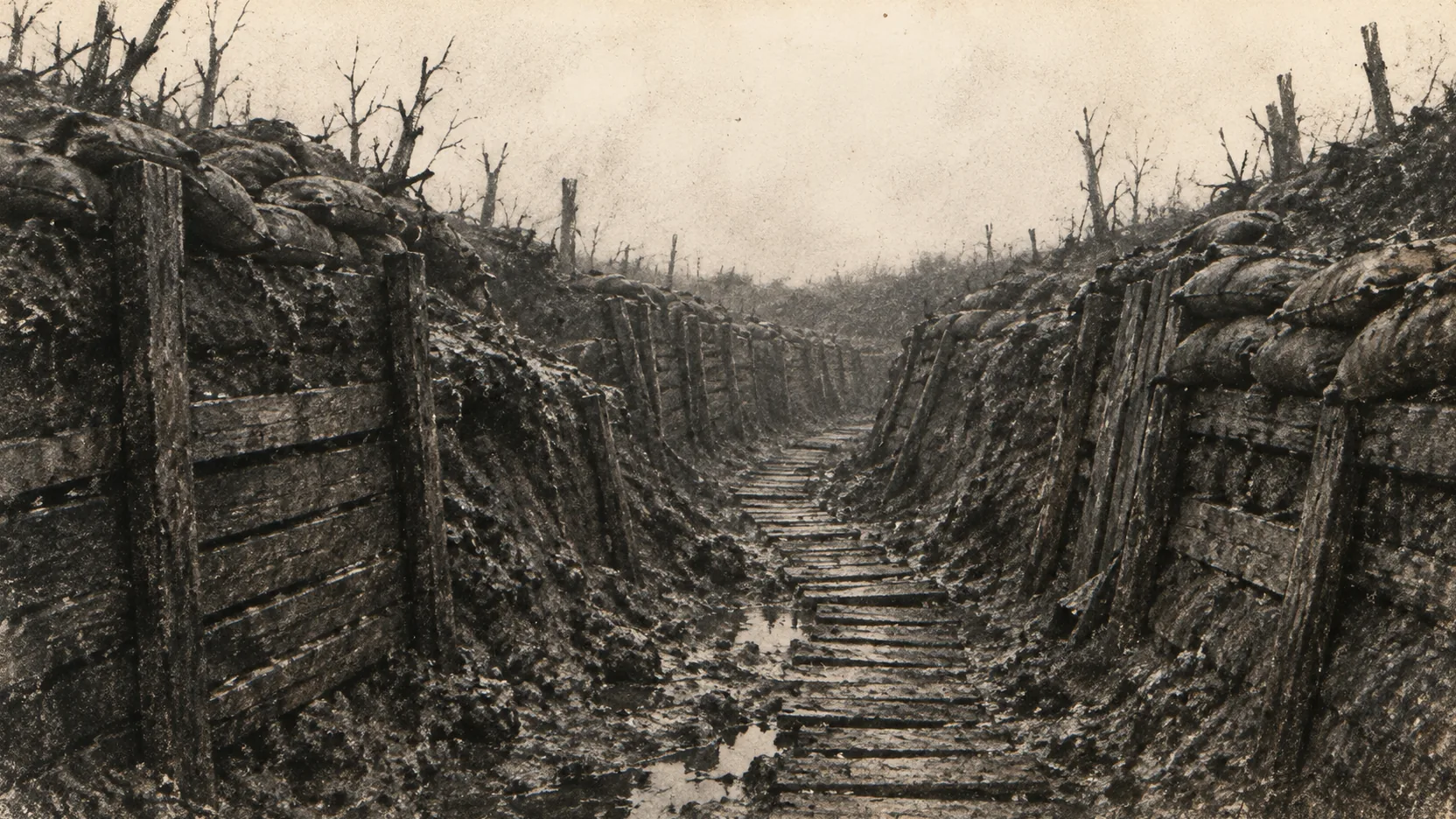

The Development of the German Imperial Army in World War I (1914–18) - An Overview
At the outbreak of World War I the Imperial Army comprised 92½ infantry and 11 cavalry divisions with 5,124 field guns and 575 heavy guns.
In World War I the German Army experienced not only an enormous increase in strength but also lasting structural changes.

After mobilization reached the planned number of soldiers, those responsible quickly recognized the necessity of comprehensive reinforcement. Already in August 1914 the formation of five Prussian reserve corps was therefore ordered; Saxony, Württemberg and Bavaria were also to raise new units. While (superficially) the personnel issue caused fewer problems, the outfitting, equipping and arming of the new units was hard to accomplish.

In view of the tense situation on the Western Front the inadequately trained reserve corps were deployed prematurely and therefore suffered unnecessarily heavy to very heavy losses. Associated with this disaster is the legend of Langemarck, according to the official army report west of that locality “young regiments, under the singing ‘Deutschland, Deutschland über alles,’ advanced against the first line of the enemy positions and (they) took them.” To this Unruh: “People spoke of young regiments, the term ‘boys of Langemarck’ was coined and one overlooked, probably deliberately, that members of older age groups also suffered and bled heavily on the Flemish front in October and November. It was, alongside the youth, above all the men of the Landwehr who in the autumn of 1914 had to pay the barbaric price of Langemarck, Dixmuiden and St. Eloi. In most cases miserably led and inadequately equipped (they especially lacked spades) they were driven with their young comrades into ever-new attacks that were doomed to fail from the outset”1.

By the end of the first year of the war the War Ministry had already ordered the further formation especially of infantry formations; in total 4½ reserve corps were to be ready to march by the second half of January 1915. By the end of the war there were 13 (previously 8) armies, 53 (previously 40) army corps, 161 (previously 92) infantry divisions, 24 (previously 21) independent brigades, 4 (as before) cavalry corps and 11 (as before) cavalry divisions.
However, the composition of the divisions had changed noticeably.


In 1914 a division consisted of 2 infantry brigades, each of 2 regiments of 3 battalions and 1 machine-gun company; 1 cavalry regiment of 3–4 squadrons; 1 field artillery brigade of 2 regiments of 2 detachment units of 3 batteries of 6 guns; 1–2 pioneer companies; 1 divisional bridge train and 1–2 medical companies.


In 1918 a division was composed of 1 infantry brigade of 3 regiments of 3 battalions with 1 machine-gun company and, at the regiment level, 1 trench-mortar company, 1 squadron of cavalry, 1 artillery commander with 1 field artillery regiment of 3 detachments of 3 batteries of 4 guns and 1 foot artillery battalion of 3 batteries of 4 guns, 1 pioneer battalion of 2 companies, 1 trench-mortar company, 1 portable searchlight detachment, 1 signals commander with 1 telephone and 1 radio operator detachment, 1 medical company, 2 field hospitals, 1 motor transport column, 1 horse hospital and 1 recruit depot.
The individual arms underwent profound transformations during World War I.

In 1914 the German infantry comprised 217 regiments.
In addition there were 18 Jäger/Schützen battalions.
On mobilization one active infantry regiment (training infantry regiment) and 114 (113) reserve infantry regiments were raised.

The reserve regiments were formed by the active regiments (or by the district commands). Frequently the numbering of the reserve corresponded to that of the active regiment. The reserve regiments regularly counted 3 battalions and usually had machine-gun companies. However, there were already deficits in 1914. According to Schack, for the 133 reserve infantry regiments only 88 MG companies existed.
The number of Guard reserve regiments was small; they had problems drawing their reservists (from across the Reich).
The active regiments (those already in existence before 1914) also transferred active soldiers to the reserve units.
The reserve infantry regiments were usually commanded by lieutenant colonels and consisted of older age groups. Further reserve infantry regiments were formed in September and December 1914, in May 1915, and in August, October and November 1916.
These units, grouped into reserve corps, consisted of men who had previously served and were not held back but were immediately deployed in the front area like the active formations. This increased the number of available formations, which surprised the opponents.

Since the conscription of reservists from across the Empire was particularly difficult for the Guard regiments, only two Guard reserve regiments were formed in addition to the training infantry regiment. However, in World War I new Guard infantry regiments and Guard brigade replacement battalions (Nos. 1–6) were also created.
Thus the 6th and 7th Guard Regiments were established with their own uniform.


The replacement battalions remained at home. The mobilization plan provided one such battalion for each active, reserve and Landwehr infantry regiment.
They were regularly housed in the vacated barracks in their home garrison.
Separate (independent) replacement machine-gun companies were also provided for the machine-gun companies.
The replacement formations were actually supposed to train the new soldiers and send them to the front to the fighting formations.
However, the constant need for new troops led to the formation of the so-called brigade replacement battalions. These were formed from two companies each from the replacement battalions of the two regiments of a brigade and were partly equipped as mobile units, and also grouped into replacement divisions (without regimental association).
Despite non-uniform organization and inadequate equipment, such units proved themselves in combat.

From 1915 the (remaining) brigade replacement battalions were assembled into actual regiments; in part they still bore the designation 'replacement regiments' as a reminder of their origin.
Similar formations arose from the replacement battalions of the reserve/Landwehr regiments.

Already in the autumn of 1914 there were major reorganizations; further new formations followed from 1916 onward.
The highest numbering were the Württemberg replacement regiments No. 478 and 479.


In World War I the Landwehr was organized into regiments, brigades and divisions and a Landwehr corps and was deployed on many fronts, not only as an occupation force.
In 1914 a total of 98 (96) Landwehr infantry regiments were mobilized or formed.
In the following years further Landwehr regiments were created.
The (Saxon) Regiment No. 100 was called the Grenadier Landwehr Regiment.


There were mobile and immobile Landwehr regiments.
None of the Landwehr infantry regiments had machine-gun companies. Therefore fortress machine-gun detachments and reserve fortress machine-gun detachments were assigned.

Older age groups and conscripts of lesser physical fitness formed the Landsturm. With the start of World War I independent Landsturm battalions were formed. They were usually employed in the rear areas and at home.
Initially the Landsturm battalions were formed as immobile units, but later, with young replacements, were also converted into field battalions.
According to Kling/Stein there were 340 Landsturm battalions in 1914; by 1918 there were about 710.
From 1915 Landsturm regiments were also established. Some of these units served to secure borders and as coastal defense.

Kling/Stein list the following strength for the infantry (excluding Jäger and Schützen etc., and also excluding the Landsturm):
Peace units: 12 guard formations, 182 line infantry regiments (excluding Bavaria), 24 Bavarian infantry regiments = 218 units
Reserve infantry regiments = 113 units
Landwehr infantry regiments = 96 units
Brigade replacement battalions = 86 battalions
Extra-schedule formations:
Reserve infantry regiment Metz = 1 unit
Reserve brigade replacement battalions = 12 units
Landwehr brigade replacement battalions = 21 units
Landwehr battalions of the IV Army Corps = 6 units
Westphalian Landwehr battalions Breslau I - IV = 4 units
Mobile replacement battalions = 58 units
In addition to be considered: the Württemberg mountain regiment, the naval infantry and sailor regiments, the infantry battalions No. 701 - 703 deployed in Palestine, the assault battalions, the machine-gun formations.


At the outbreak of the First World War there existed the Guard Jäger Battalion, the Guard Rifle Battalion, Jäger battalions Nos. 1 - 11, the Saxon Jäger battalions Nos. 12 - 14, the Mecklenburg Jäger battalion and the 1st and 2nd Bavarian Jäger battalions. In 1915 Jäger Battalion No. 27 was formed and in 1916 Jäger Battalion No. 28.
Jäger Battalion No. 3 was converted into an assault battalion in mid-1916.
Subsequently various Jäger regiments were formed from the Jäger battalions. The battalions, however, remained independent.


Already in peacetime (from 1913) the Jäger and Schützen battalions included, besides the 4 Jäger or Schützen companies, 1 machine-gun and 1 cyclist company.
From autumn 1914 a second cyclist company was formed in the Jäger and Schützen battalions.
Thus in 1914 there were 18 cyclist companies.
The reserve Jäger battalions had no cyclist companies.
For training purposes, replacement cyclist companies were already formed in the Jäger battalions in autumn 1914.

During the war cyclist formations were formed in many infantry regiments etc.
According to Stein, during the course of the war 19-20 Jäger companies and about 45 cyclist companies formed by the infantry and their replacement formations were added.
There were also reserve cyclist companies.
These cyclist companies or detachments usually bore the number of the corresponding division.
In the West, after the onset of trench warfare, many cyclist formations were disbanded, whereas on the Eastern Front — where the war was still characterized more by movement — they were retained.
Exact information on the cyclist units in existence is problematic, however, since these formations were, as mentioned, sometimes disbanded and later reformed.

From the summer of 1916 full-fledged cyclist battalions were formed (Kling/Stein list 8 corresponding units).
The cyclist units were intended to increase the firepower of the cavalry divisions.
The strength of a cyclist company is given as 150 non-commissioned officers and men.


As a reaction to the declining firepower of the numerous new units and especially to the special demands of trench warfare, assault troops were already formed in the autumn of 1914.
These were intended for large-scale assault troop operations or for attacks with limited objectives.

Modeled on the first assault detachment formed from pioneers at the VIII Army Corps and the famous Rohr assault battalion (formerly a company commander in the Guard Rifle Battalion), further special formations gradually emerged.
Stein names a total of 18 assault battalions, including the Jäger-assault Battalion No. 3.
Assault Company No. 18 was formed on 07.08.1917 and from 22.08.1918 became Assault Battalion No. 18.

They were regularly equipped with mines, flamethrowers, guns etc. and additionally reinforced by 1–2 machine-gun companies.
They were elite units.
In 1918 the strength of the assault troops is said to have amounted to over 19,000 men.


There had long been efforts to increase the rate of fire of small arms and thus their effectiveness, but only with the invention of mobile and fixed automatic small arms with high rates of fire — machine guns as recoil-operated weapons with a movable barrel and water cooling — did the breakthrough occur. These automatic machine weapons became the defining element of modern war and changed warfare fundamentally.
After initial material and firing trials from 1889 and again from 1894, from 1904 proper machine-gun detachments were formed, and from 1907 machine-gun companies were established at brigade and later at regimental level.


The growing importance of machine guns as the main firepower of infantry in trench warfare shows the dynamic development of this weapon. At the outbreak of the war the German army had 360 machine-gun companies/detachments; by the end of 1915 there were already 450. In addition there were at that time 80 machine-gun platoons in the cavalry. The machine guns were, however, constantly increased. In the autumn of 1916 it was decreed that from now on each infantry battalion had to have 1 and each Jäger and assault battalion 2 machine-gun companies. At the same time, additional machine-gun sharpshooter detachments (each of 3 companies) were formed.

In 1918 there were a total of 2,300 machine-gun companies (= 27,600 machine guns). According to other sources the number of machine guns at the end of the war was about 100,000. Common was the heavy machine gun 08 on a sled-leg mount. It was a recoil-operated weapon with a movable barrel and water cooling. Ammunition was fed by a belt. There were also machine guns with protective shields. The model used in the German army around 1914 weighed about 65 kg and had a rate of fire of about 500 rounds/min. Later significantly lighter models were introduced so that they could better keep up with advancing infantry. These weighed only 17.5 kg. Above all, the machine gun, through its enormous repelling effect, forced the belligerent parties to entrench and thus froze the fronts.
Cavalry had to dismount and the automatic machine gun henceforth ruled the battlefield.
For fighting in the Vosges, but also in East Prussia and above all in the Carpathians, specially equipped units were required for combat in mountainous terrain, especially in winter.


Four snowshoe battalions were formed, namely
in November 1914 the Bavarian Snowshoe Battalion No. 1,
in December 1914 Snowshoe Battalion No. 2,
in May 1915 Snowshoe Battalion No. 3 and
also in May 1915 the Bavarian Snowshoe Battalion No. 4.

In Munich there was a snowshoe replacement detachment (established in December 1914).
The four Bavarian snowshoe battalions were finally consolidated in 1915 into Jäger Regiment No. 3.

Beginning in December 1914 a Württemberg formation was also created.
This remained an independent unit and was called from the end of March Württemberg Mountain Company No. 1.
In the autumn of 1915 this formation was expanded into a Württemberg Mountain Battalion.
From May 1918 there were then two battalions combined into the Württemberg Mountain Regiment.


With Italy's declaration of war in May 1915 a situation arose that threatened Austria-Hungary. Apart from the garrisons of fortresses, the active troops intended for defense in the high mountains, the k.k. Landesschützen regiments, were on the Eastern Front in Galicia. The Danube Monarchy initially had to organize a defensive line from Standschützen and other improvised formations. The German Supreme Army Command was aware that with the small forces Austria-Hungary could now deploy to defend the Tyrolean border, the danger to southern Germany could become very great. The best security for Bavaria was therefore Tyrol. Already in the spring of 1915 they had begun to assemble the Alpenkorps — a reinforced infantry division — around a Bavarian core from proven German units.
According to its future use in the high mountains the Alpenkorps was to receive mountain equipment (e.g., snowshoes, ice picks, mountaineering boots, etc.).
Because the Alpenkorps also needed corps troops to carry out its missions, this military formation, despite the manpower of a division, was designated as a corps.

The German Alpenkorps consisted of the 1st Royal Bavarian Jäger Brigade (Major General Ludwig von Tutschek) with the Bavarian Infantry Life Regiment and the 1st Bavarian Jäger Regiment, as well as the 2nd Jäger Brigade (Colonel Ernst von Below) with Jäger Regiment 2 (Hannoverian Jäger Battalion No. 10, Reserve Jäger Battalion No. 10 and the Grand Ducal Mecklenburg Reserve Jäger Battalion 14) and Jäger Regiment 3, consisting of the former four snowshoe battalions.

Additionally there belonged 6 cyclist companies, 7 machine-gun detachments (mountain machine-gun detachments), 48 field and mountain guns and one battery each of 10-cm guns and 15-cm howitzers, furthermore mortar detachments, pioneer companies, signals troops, etc., and at times also the Royal Bavarian Field Aviation Detachment 9 b.

Another special formation of the German Imperial Army in the First World War was the Carpathian Corps.
This troop formation comprised the 1st Division (Königsberg) with the Grenadier Regiment “Kronprinz” (1st East Prussian) No. 1, Grenadier Regiment “König Friedrich Wilhelm I.” (2nd East Prussian) No. 3 and the Infantry Regiment “Herzog Karl von Mecklenburg-Strelitz” (6th East Prussian) No. 43. Furthermore included was the newly formed 200th Infantry Division, which consisted of Jäger Regiment 3 (formerly of the Alpenkorps) and Jäger Regiments 4 and 5.

The Carpathian Corps was intended to support the Austro-Hungarian ally and initially fought on the Eastern Front in Romania, from September 1917 on the Italian Front and then from February 1918 on the Western Front.
A special badge of this large formation was the Carpathian Corps badge. This showed a stag's antlers with a fir bough and a sword and was worn on the cap between the two cockades.

Little known is that the German Empire not only provided its ally Turkey with material aid in the form of arms deliveries, but that German troops also fought on the territory of the Ottoman Empire, in total about 25,000 men.
At the request of the Turkish ally an expeditionary corps — called Pascha I — was already assembled in March 1916.
In the following year the predecessor of the later Asia Corps (also called the Levant Corps) was formed (Pascha II) and sent to the Orient from August (commander: Major General Werner von Frankenberg and Proschlitz).
The composition of the aforementioned corps — at various times — is shown in the table below. In addition, each included railway troops, truck units and aviation detachments.

The task of Pascha II was above all to stop the advance of the British in Palestine. The original objective of recapturing Baghdad was soon abandoned.

After the defeat of the Turkish-German army in Palestine and Mesopotamia and especially after the capture of Damascus, the troops retreated further and, after the capitulation of Turkey in October 1918, were initially taken to Constantinople and interned there and from there gradually returned to Germany.


Pascha I | Pascha I 1917 | Pascha II 1918 |
Infanterie-Bataillon 701 MG-Bataillon 601 | Stab der 201. Infanterie-Brigade Infanterie-Bataillon 702 | MG-Bataillon 602 1. Masurisches Infanterie-Regiment Nr. 146 (Allenstein) |
Infanterie-Bataillon 703 MG-Bataillon 604 | Pionier-Kompanie 205 Artillerie-Abteilung 701 | MG-Bataillon 606 |
Gebirgs-MG-Abteilung 201 Flak-Batterie 15 | MG-Bataillon 607 Gebirgs-MG-Abteilung 203 | Pionier-Kompanie 701 Flak-Zug 28 |
Gebirgs-MG-Abteilung 207 MG-Abteilung Hentig | Flak-Zug 133 Gebirgs-MG-Abteilung 208 | Armee-Nachrichten-Kommandeur 70 Flak-Zug 136 |
Reserve-Jäger-Bataillon 11 (Marburg) | Flak-Zug 142 Gebirgs-Artillerie-Abteilung 1 | Flak-Zug 172 |
7./Fußartillerie-Regiment 2 | Fußartillerie-Bataillon 60 | 7./Fußartillerie-Regiment 9 |
Tragbare Funkstation 2 und 4 Flakzug 120 | verschiedene Flieger-Abteilungen | Gebirgs-Funker-Abteilung |
Funkerzug 1720 | Funkerzug 1731 | Lichtsignalzug 27 |
Lichtsignalzug 28 | Telegraphen-Abteilung "Klein-Asien" |
|
| Flak-Zug 172
| 7./Fußartillerie-Regiment 2
|
| Fußartillerie-Bataillon 60
| 7./Fußartillerie-Regiment 9
|
| Tragbare Funkstation 2 und 4
| Flakzug 120
|
| verschiedene Flieger-Abteilungen | Gebirgs-Funker-Abteilung
|
|
| Funkerzug 1720
|
|
| Funkerzug 1731
|
|
| Lichtsignalzug 27
|
|
| Lichtsignalzug 28
|
|
| Telegraphen-Abteilung „Klein-Asien“
|

Turkey initially had no air arm; for this reason German aviation detachments were deployed, among others, in Palestine. In 1917 the Prussian aviation detachments 301, 302, 303 and 305 and the Bavarian aviation detachment 304 b were intended for service in the Near East. In addition to these units a fighter squadron also fought in Palestine in 1918; another fighter squadron existed only briefly. In total the German Empire provided Turkey with about 460 aircraft; 34 German aviators — serving in Turkish service — alone were killed. Of the German aviation detachments only wreckage remained.


In 1914 the German Empire had 110 active cavalry regiments.
A distinction was then made between army and divisional cavalry.
In the course of mobilization 66 regiments formed 11 cavalry divisions.
The remaining regiments were used as divisional cavalry (with the infantry divisions).


Most cavalry regiments in 1914 consisted of five squadrons, however only four of these deployed to the field.
One squadron remained in the home garrison and had the task of providing replacements for the active regiment.
The regiment that marched to the front thus counted 30 officers and 690 men.
The replacement squadrons mostly still wore the colorful peacetime uniforms.

In addition, cavalry replacement detachments were formed, which were assigned to the divisions made up of brigade replacement battalions.
These units, named after the garrison of their respective parent troop unit, were later reorganized or dissolved in 1916.

Furthermore, 33 reserve regiments were formed from the active cavalry regiments.


In addition to mobile replacement squadrons, (59) mobile Landsturm squadrons were formed, which, for example, were employed on the eastern theater of war.
Additionally, individual squadrons were at times combined into regiments.

From the autumn onwards, so-called reserve cavalry detachments were additionally formed and assigned to the newly raised reserve divisions.

To strengthen the firepower of the cavalry formations, they received MG platoons from 1915. In 1916 further restructurings followed, so that each division now retained only one squadron as divisional cavalry for reconnaissance and signaling duties. The remaining cavalry units largely lost their horses and were henceforth employed infantry-style as rifle regiments. Due to a shortage of horses, many squadrons of the Landwehr, etc., were subsequently disbanded.


The reserve cavalry regiments were also in part reorganized into (12) rifle regiments.

According to Kling, in spring 1918 only the following units from the active cavalry regiments were still used as divisional cavalry:

Furthermore, individual squadrons of other active cavalry regiments were used with infantry divisions. In the East, in 1918 various cavalry regiments were still employed mounted or took part unmounted in the so-called expedition to Finland; on the Western Front some mounted units performed policing duties in the occupied territories.

The Guard Cavalry Rifle Division particularly distinguished itself in the fighting in the West; many time-honored cavalry regiments of the Old Army belonged to it.


Because of the repulsive effect of modern machine weapons, the original significance of the cavalry was already quickly marginalized at the start of the war. This painful process of realization, however, was not equally perceived by all military men; for example, one could still read in 1915/16 the following: "Before the war it was often believed that the cavalry had played out its role. Reconnaissance was to be carried out solely by aircraft and combat activity seemed excluded. The present world war has, however, demonstrated the falsehood and error of these views. Cavalry still fulfills a significant and decisive role both in reconnaissance and deception duties, as well as on the battlefield itself. As important as the work of the airships is, they cannot by themselves fulfill all tasks due to their dependence on the weather. Cavalry must therefore always still be employed alongside them. The concealment of one’s own measures and movements can in no way be carried out by any other arm...3."

Even at the start of the war emphasis was placed in the training of replacements on fighting with the lance. A wartime volunteer reports: "Today we rode differently than usual, and when we stopped I didn't really know whether I could stand on my feet, nor whether my fingers were torn off or only cut, as later proved to be the case. I was actually convinced that I could no longer endure the service. In the afternoon it got better. We were brutally put through lance fighting and endless, very rapid alternation of sustained running, lying down, sustained running, etc. The others were completely exhausted, but I held up quite well. However, the non-commissioned officer had beforehand declared that we were far too young, we couldn't even hold the lance"4.

In his account of the Battle of Tannenberg Uhle-Wettler judges: "Thus the first battle of the war already painted the picture of almost all battles of that year: infantry and artillery fought with the greatest devotion, while the cavalry almost refused combat and only rarely fulfilled its missions, perhaps because it had been trained only for reconnaissance"5. At the very least, the reality of war was merciless toward traditional ties; due to the conditions of modern warfare and a shortage of horses most cavalry regiments—as shown above—lost their horses. At the same time there was an adaptation to infantry armament. The era of the classical cavalry was finally over6.

Artillery also underwent a major transformation in the World War. Already at the beginning of the First World War the 5th and 6th Guard Field Artillery Regiments were formed.
The regiments each consisted of 2 mobile detachments with 3 batteries each.
Some regiments still had a mounted detachment until 1916/17.
Ammunition columns also belonged to the field artillery regiments.

In addition to the line units, many reserve formations were raised. Over the following years numerous further formations were created (up to No. 602), in some cases only as independent field artillery detachments.

As part of the mobilization, each infantry division was assigned 1–2 field artillery regiments; active divisions had more, reserve divisions fewer.

The reserve corps newly formed in the autumn of 1914 were also equipped with less field artillery. This of course meant reduced firepower. Over time (from 1917) all field artillery regiments consisted of only three detachments with four guns each.


A larger stock of ammunition was intended to compensate for the smaller number of guns per battery. However, this measure made it possible to form a greater number of batteries and to distribute them more evenly.
The (light) ammunition columns assigned to the units were fed into the general artillery ammunition columns, but from the March Offensive of 1918 were reassigned to the units again for reasons of mobility.

In addition, infantry and mountain batteries were formed.
In 1918 there were a total of 2,832 batteries with 11,328 guns together; in 1914 there had been 941 batteries with 5,646 guns.

The heavy artillery was intended to—preferably from covered positions—blast fortifications and emplacements to pieces and to defeat the enemy artillery. It was assigned to the respective army corps.
Because there was too little heavy artillery, at first only the active army corps could be equipped with the corresponding batteries.
However, all available batteries and gun matériel were mobilized in order to equip the other reserve corps with the heavy artillery considered indispensable.

From 1916 further regular foot artillery regiments were formed. In the war the foot artillery was deployed piecemeal, so that the regimental formation was increasingly displaced.
Independent foot artillery battalions and batteries were formed.

In addition there were reserve foot artillery regiments/battalions, Landwehr and Landsturm foot artillery, replacement and garrison units.

The ammunition columns of the foot artillery have already been mentioned; in addition there were ammunition depots and artillery measurement formations.
The replacement formations often wore the colorful peacetime uniforms, as with the other branches of service.

The heavy and heaviest artillery was also massively expanded. The following figures show this: in 1914 there were 147 batteries; in 1918 there were 1,575 batteries. Monthly production of heavy guns for the German army in 1917 averaged 400; for the field artillery 3,000 guns per month were produced. Due to shortages of raw materials, however, these figures fell markedly in 1918. In that year the German army had nearly 18,000 guns on all fronts. These figures demonstrate the outstanding importance of artillery in World War I.

At the beginning of the war artillery was still regarded as an auxiliary arm, but actual developments quickly showed that this was an outdated tactical approach. The overwhelming majority of European military leaders still considered infantry the main arm, while the role of cavalry was disputed. With the onset of positional warfare, daily life at the front resembled the conditions of siege warfare and technical weapons consequently moved to the center of events.


For years both the Central Powers and the Allies tried to break open the frozen fronts by an ever-increasing use of guns with the corresponding consumption of ammunition. As a result, gigantic material battles shaped the situation, especially on the Western Front; on the Eastern Front certain elements of maneuver warfare remained. The enormous use of materiel—for example by the Germans at Verdun (from February 1916) or by the British on the Somme (from June 1916)—was not justified by the respective territorial results, but the guns dominated the battlefield and the barrage transformed the fronts into eerie crater landscapes. It took many years (and enormous losses) until, for example, the German military leadership realized that this method of fighting generally cost the attacker more than the defender. After the replacement of Lieutenant General von Falkenhayn, the Germans therefore pursued new paths under Field Marshal von Hindenburg and General Erich Ludendorf in the last great offensive (Operation Michael) from March 1918 in Flanders; by then, however, it was too late in view of the Allies’ meanwhile marked material superiority.

To increase accuracy and thus particularly the effectiveness of heavy artillery, a complex firing and measurement system was developed with a modern military meteorological service including field, army, group and front weather services. Already in September 1915 there were 101 artillery measurement teams; by 1917 there were 178 (now called light measurement teams – LM). At that time there were also 130 sound-ranging teams (SM) that attempted to calculate the locations of the enemy artillery from the muzzle reports.


The engineer arm gained enormous importance in the trench- and entrenchment-dominated conflict of World War I.

The 35 pioneer battalions with about 21,000 men that existed at the outbreak of war were greatly increased over the years and, for example, were given additional tasks by gas warfare.

The pioneer arm also had searchlights, mortars, and flamethrowers, which later were used in conjunction with the aforementioned infantry assault troops.


Some pioneer battalions were expanded to regiments (but dissolved again in 1917).
By the end of the war there were 590 pioneer companies and 175 searchlight detachments.

The first mortars were already developed before the outbreak of war.
They were usually smoothbore, high-angle firing guns that fired shells and were primarily intended for siege warfare. In relation to the usual guns they had only a short range, and were therefore intended mainly for close combat.
Minenwerfers were used for the first time during the siege of Port Arthur in 1904.
The first German models were heavy and medium mortars that could hurl shells or mines about 400 m and 759 m respectively. In essence the minenwerfer followed the principle of the mortar. They were muzzle-loaders, although larger calibers were designed as breech-loaders. In trench warfare the importance of this weapon quickly became clear; above all light and thus more easily transportable minenwerfers with a range of up to 1,000 m played an important role in infantry combat. With them the enemy behind cover could be hit.

At the beginning of the war there were 70 heavy and 110 medium minenwerfers. Later the light minenwerfers mentioned above were designed and further developed. The minenwerfer units were continually increased. Initially they belonged to the pioneer arm.

Each pioneer battalion received a minenwerfer company; as the force was further expanded each infantry, jägers and rifle battalion then received four light mortars, only the heavy and medium minenwerfers remained divisional troops.
The latter continued to be operated by pioneers; the light minenwerfers became exclusively an infantry weapon.
Ultimately there were 23 minenwerfer battalions, 250 minenwerfer companies and 580 minenwerfer detachments. In total there were 1,700 minenwerfers.

In 1914 there existed the Guard Train Battalion as well as 21 train battalions, including two Saxon units (No. 12, 19), one Württemberg unit (No. 13) and one Hessian unit (No. 18). In addition came Bavarian Train Battalions No. 1–3.

The train detachments were dissolved upon mobilization. Each formed a replacement detachment in their home garrison and were converted into numerous wartime formations or provided the corresponding cadres for them.


According to Jürgen Kraus (p. 733), each army corps included:
6 provisions, 7 vehicle park columns, 2 horse depots and 2 field bakery columns.
This basically also applied - albeit with weaker equipment - to the reserve and Landwehr corps. Independent divisions were also equipped accordingly.
There were also stage (Etappe) formations. Slaughterhouses at corps level, and later at division level, were responsible for supplying meat.


Wartime formations continued to increase with the growth of the army and the fronts, and by the end of the war there finally existed:
180 provisions, 444 vehicle park, 331 stage vehicle park, 292 magazine vehicle park columns, 140 horse depots, 148 field bakery, 75 stage bakery and auxiliary bakery columns, 19 pack-animal columns and 287 field slaughterhouse columns.

During the war the railway troops were continually expanded because of their important role in transporting soldiers and supplies. For track construction 121 railway construction companies were established. Railway operating companies were responsible for transport and the operation of the railways. In the front area narrow-gauge field railways and corresponding units handled transport. There were also a number of specialist formations.

In the occupied territories the German railway had 24,000 km of standard-gauge and 4,000 km of narrow-gauge track. Between 8,000 and 9,000 locomotives and about 18,000 railway wagons were available.

The railway formations comprised about 178,000 personnel in 1918, including 75,000 civilian railway employees. Prisoners and inhabitants of the rear-area regions were used for the extensive construction work.

In mid-1918 there were on the various German theaters of war 7,760 standard-gauge and 940 narrow-gauge locomotives, and the number of available railway wagons is reported as about 180,000.

In 1914 the German army mobilized partially with civilian motor vehicles, whose drivers, however, held officer rank.

The truck service, however, was organized exclusively militarily. Initially each army had a commander with a motor vehicle park, and the cavalry divisions and the Jaeger battalions had motor vehicle columns.

In 1915 the motor vehicle service was reorganized and motor traffic better controlled.
The cavalry and the Jaegers lost their motor vehicle columns to the rear area. Meat motor-vehicle columns (with the reserve corps, dissolved again from autumn 1915) and stage medical motor-vehicle detachments were formed.

There were also postal motor vehicle parks (later incorporated into the army motor vehicle squadrons).
From autumn 1915 the general commands each received a corps motor vehicle column, and divisions not attached to a corps each received their own divisional motor vehicle column.

Through the reorganization from 1916 the motor vehicle troops became army troops and the exclusive attachment to the rear area was abandoned. Extensive restructurings took place. At the end of 1916 all divisions received their own divisional motor vehicle column. In 1917 vehicles were then also consolidated into so-called army motor vehicle columns as army reserve, incorporating previously existing Jaeger, cavalry, rear-area and foot artillery ammunition motor-vehicle columns.

At the head of the motor vehicle troops stood (since 1916) the Chief of Motor Transport at the Supreme Headquarters, to whom the inspection of the motor vehicle troops at home also reported.
Special commanders of the motor vehicle troops ensured implementation of the Chief of Motor Transport's directives at the various organizational levels.

In 1918 the German army had a total of 5,400 motorized motorcycles available. These were organized into motorcycle rider detachments.
The tasks of the motorcycle riders were message service duties for higher staffs and the columns.

As early as 1830 a telegraph section was established in the Guard Pioneer Detachment.
The telegraph troops were initially not considered an independent branch of service, but belonged to the transportation troops.
In 1914 there were 6 Prussian telegraph battalions, whereby Nos. 1–5 each had 3 wire and 2 radio operator companies and No. 6 had, in addition to 3 wire companies, only 1 radio operator company.
In addition there was one Saxon (No. 7) and two Bavarian (Nos. 1–2) telegraph battalions.

The telegraph battalions did not deploy as complete units, but formed numerous wartime formations.
In the course of further reinforcement numerous signal detachments (Nos. 1–519) were created at division level.

Upon mobilization the newly formed formations wore sleeve insignia with different markings, mostly a “T” or “F” with an Arabic number.
After reorganization into the signal troops and a uniform regulation of the uniforming, the sleeve insignia for the field formations were discontinued.

From 1917 the telegraph troops were converted into the independent signal troops.
The mobile formations were distributed among the large units.
At home there were the Guard Signal Replacement Detachments, Signal Replacement Detachments Nos. 1–21, the 1st–3rd Bavarian Signal Replacement Detachments and several signal schools.


The continual expansion of the signals troops was the result of the growing importance of communication in modern warfare.

The airshipmen belonged to the transport troops. Before the mobilization of 1914 there were 5 airship battalions (established in 1884, 1911 and 1913). In addition there was a Bavarian air and motor-vehicle battalion. On the dark blue dress uniform the airshipmen wore a yellow L with the respective battalion number on the shoulder straps. This insignia was also worn on the field uniform. Besides operating and manning the classic airships, the use of tethered balloons was also among their tasks. In addition to the 24 airship detachments formed at mobilization (disbanded from 1917), there were 9 field airship departments and 15 fortress airship detachments (converted into field airship departments from 1915).
From 1917 independent balloon trains were formed; by 1918 there were a total of 184 of these in the German army (and 56 field airship department staffs).

The purpose of the field airship formations equipped with tethered balloons was reconnaissance and surveillance as well as directing artillery fire. The kite balloons used from 1916 could ascend up to 1,500 m and had a gas volume of 850 cubic meters.

The tethered balloons were at first hauled in laboriously with hand winches, later — from 1915 — with power winches. For safety the observer had a parachute; later there was a basket parachute, i.e., the whole basket could be detached from the balloon if under fire. In total, over 500 balloons were shot down by enemy aircraft or artillery.

Already in the second half of the 19th century technological progress led to increasing specialization. The invention and military exploitation of the railway and the motor vehicle increased the mobility of mass armies, and the introduction of the telegraph and the telephone also ensured command contact with widely dispersed or distant front lines in the shortest time. In the First World War technical development, under the pressure of circumstances, unfolded at an unprecedented speed with lasting effects on weapons and thus on warfare. This is particularly evident in the rapid establishment and expansion of the air service.

At the beginning of the war the air arm was still essentially in the process of being built up, but it grew manyfold within a very short time. Initially aircraft on both sides were used solely for operational aerial reconnaissance. Very quickly, however, the various branches of the air forces emerged: field, artillery and fighter aviators.


While the field airship troops with their tethered balloons retained a certain importance for observation and reconnaissance in trench warfare, the army and naval airships did not prove successful. In particular in land warfare they proved too slow and, as large targets, too vulnerable.
In response to the increased expansion of the air forces, anti-aircraft guns were developed and machine guns were employed accordingly.

The young air force was employed not only in the front and rear areas but also for attacks far into the enemy’s hinterland. There were German air raids on Paris and London, and Allied aviators also attacked German cities, e.g., on 08.10.1914 against the airship hangar in Düsseldorf. The first German air raid took place on 26.12.1914 with a Zeppelin and a Taube.

The field aviators operated as observation (photographic reconnaissance) and infantry aviators. In addition there were bomber squadrons, and the navy also had its own air service.
The medical personnel of the German army before the war consisted of medical teams, stretcher-bearers, military orderlies, as well as medical officers, officer candidates, military pharmacists and hospital administrative officials. The former were attached to the individual formations and were drawn from the ranks.
The stretcher-bearers and military orderlies belonged to the train.
In peacetime stretcher-bearers existed only for exercises and maneuvers (they already existed in 1813).

The medical officers were licensed physicians with various ranks. Military pharmacists and hospital administrative officials belonged to the military administration.

Medical teams had been considered combatants since 1867; from 1869 the Red Cross armband on the left upper sleeve was prescribed for them. It was probably worn for the first time in the 1866 campaign.

The orderlies traditionally wore an entirely blue uniform. From 1913 the medical teams, however, wore the uniform of their unit (with a yellow Aesculapian staff on the right upper arm).

At the head of the medical services of the German army stood the Chief of Field Medical Services in the so-called Great Headquarters. According to Cron, the O.H.L. had 11 hospital and 7 auxiliary hospital trains at its disposal.
At each army high command there was the army physician and at each rear-area inspection the rear-area physician. He was assisted by an advisory hygienist.
Here were also the patient transport departments, medical depots, etc. Each general command had a corps physician.
The individual corps had 12 field hospitals; the reserve corps had fewer.

Each division had a divisional physician with 1–2 medical companies. At the troop units there were also doctors, medical soldiers and auxiliary stretcher-bearers. From 1916 each division included one medical company and two field hospitals.
From April they formed — partly from captured vehicles — rear-area medical motor-vehicle departments. These were later reorganized and became army units.


The Etappe was the intermediate link between the front and the homeland. Without a well-functioning rear area the front was not effective. Each army had its own Etappe, which was led by an Etappeninspekteur. The primary task of the Etappe was to ensure supply; it was also responsible for the civil administration of territories occupied by German troops. Furthermore, soldiers passing through the Etappe area had to be checked.
The Etappe included the railways and the other constantly growing transport formations that were vital to the front. For example, the 95 motor-vehicle columns at the outbreak of war had grown to 255 by the end of the war.

The maintenance of public security and order regularly required the police in civilian life, which in the Empire was recruited primarily from former military personnel.
There is also a need for a military police within the military. It was only founded and built up after the outbreak of the war.
The field gendarmerie was initially formed from former rural gendarmes. In addition, non-commissioned officers and lance corporals from the cavalry joined it.

Members of the field gendarmerie wore the typical non-commissioned officer rank insignia. A special service badge, however, were the ring collars, which were worn on a chain over the tunic and displayed the number of the army corps and the number of the respective gendarme.

Field gendarmerie detachments were assigned to the general commands, each with a headcount of 60 field gendarmes.
According to Jürgen Kraus, a total of 115 field gendarmerie divisions were formed. These also included divisions attached to the stage inspections. These had a smaller strength.
In the General Government of Warsaw there was even an entire field gendarmerie brigade.
In 1918 a special unit of the field gendarmerie was also founded in the West, which was intended in particular to counteract the dissolution phenomena within its own army.

The field gendarmerie adopted the uniform of the Prussian land gendarmerie; the other contingents did the same.
Characteristic was the dark-green tunic with cornflower-blue collar and sleeve cuffs as well as ponceau-red facings. The buttons were made of tombac.
The helmet used was the Pickelhaube modeled on that of the dragoons.

In 1915 a field-gray uniform was also introduced for the field gendarmerie.

The field post was organized after the outbreak of the war and had primarily the task of delivering official military mail as well as soldiers' letters and parcels.
For this purpose, field post offices or field post stations were, according to Jürgen Kraus, established and distributed among the various armies.
Thus there was a field post office at the Grand Headquarters.
At each army high command a field post depot was established.
Each army corps had a field post office.
Each division also had a field post depot.
Furthermore there were 517 field post stations in the armies' rear areas.

At the time of mobilization there were about 2,600 officials, whose number had grown to about 8,000 officials by the end of the war.
These officials had formerly been civilian postal officials and were made army officials upon mobilization. They had not been conscripted into military service and remained postal officials, but in army service.
They were divided into field post officials, subordinate field post officials and field post postilions. There were also field post conductors.
The militarily organized postal officials also wore their own service dress (M 1907, later M 1914 and M 1916). The Royal Bavarian Field Post M 1907 had its own service dress.

Even in peacetime the military included an extensive administrative apparatus.
Here military and civilian officials acted; there were already salaried employees before 1914 and, from 1917, auxiliary officials.
These were also uniformed; characteristic were general civil service insignia and special rank insignia.
The military civil servants were divided into upper (higher and middle) and lower officials (from Feldwebel downward); the former held officer rank.
There were various administrative areas, e.g. military civil servants served in the military administration (Intendantur), in the military justice administration, in technical institutes, and at the Reich Military Court.
Furthermore there were army music inspectors, military pharmacists, armourers, telegraph operators and the field chaplains mentioned below.
At regimental or battalion level paymasters already handled the service affairs of the units in peacetime in connection with provisioning, pay, clothing, etc. They also kept the cash. Each cavalry regiment, battalion, etc. had a paymaster, supervised by the intendantures. This was a military civil servant career. A prerequisite was, among other things, two years of active service (one-year volunteers were preferred). After some internships – among others 9 months at an intendanture – a paymaster examination had to be taken.
A list of paymaster candidates was kept at each army corps. Initially, promotion to paymaster-aspirant took place in the rank of a sergeant according to vacancies, as did promotion to paymaster. Seniority was important here.
In 1914 there were 1,593 senior paymasters and paymasters in the Imperial Army, as well as 1,360 junior paymasters.

Even before 1914 the military clergy in Prussia was organized militarily.
At the head stood a field provost; under him were 60 Catholic and 100 Protestant military clergymen.
According to Jürgen Kraus there were also military chaplains with military rank in Saxony; in Bavaria and Württemberg there were civilian clergy.
In the course of mobilization the military clergymen were made military civil servants, similar to the postal officials.
Each division had or received one Catholic and one Protestant military chaplain.
Additionally, (volunteer) civilian clergymen were employed and assigned to the divisions.
Hospital chaplains served in the military hospitals.
In Bavaria they were supported by civilian — clerical — orderlies.
There were also field rabbis (30).

By the end of the war there were 1,625 Catholic and 1,780 Protestant field clergymen.
In Prussia, Saxony, Bavaria and Württemberg the military clergymen received a proper field-gray service dress (M 1913) and later the field uniform of 1915.
This also included different official crosses according to denominations.
A violet field sash with white border stripes and the red cross on a white ground was worn over the overcoat or greatcoat.
In Bavaria members of religious orders also served in their habit with the Red Cross sash.

The First World War was marked by an enormous number of prisoners. According to the German Historical Museum (Berlin), "between 6.6 and 8 million soldiers ... were taken prisoner during the First World War. With about 60 million soldiers this corresponded to more than ten percent of all those mobilized." In the German Reich there were reportedly a total of 96 enlisted men's camps and 80 officer camps. Approximately 2.5 million men were interned in these camps.
The German Army Administration thus faced a major logistical problem and — unlike in the Second World War — attempted to carry out this task in accordance with international agreements.

Prisoners of war were also employed for work, e.g. behind the front. For this purpose, since 1915 prisoner-of-war labour battalions (151) were formed.
No regulated clothing was prescribed for the prisoners of war; however they wore identifiers, e.g. in the form of metal plates on their caps or cloth strips with numbers, etc.
Interpreters were identified by armbands with an appropriate print or inscription.

Sources - used and further ...
General
Collenberg, Frhr. Ludwig Rüdt v., The German Army from 1867 to 1918, in: Karl Linnebach (ed.), German Army History, Hamburg 1935, p. 336 ff.
Kabisch, Ernst, The Development of the German Army in the World War, in: Das deutsche Wehrwesen, Stuttgart-Berlin 1935.
Kraus, Jürgen, The Field-Gray Uniforming of the German Army 1907-1918, Two Volumes, Osnabrück 1999.
Stachelbeck, Christian, Germany’s Army and Navy in the First World War, 2017.
van den Bergh, Max, The German Army before the World War, Berlin 1934.
Special
Eckardt, W., German Musket Units in the World War, in: Journal for Military Studies, 1932, p. 355, 400 and 436 (of the reprint).
Kling, The Reformations of the German Infantry in the World War, in: Society for Military Studies, Text Supplement of the ... Uniform Pages, 1929, No. 9, p. 33 and 43 (of the reprint).
Kling, New Guard Infantry Regiments in the World War, in: Journal for Military Studies, 1939, p. 140 (of the reprint).
Kling, Hans, On the Formation History of the Infantry 1914/18. The Brigade Replacement Battalions, in: Journal for Military Studies 1957, p. 18 (of the reprint).
Kling, Hans, On the Formation History of the Infantry 1914-18. The Landwehr Infantry Regiments raised at mobilization, in Journal for Military Studies, 1960, p. 35, 53, 77 (of the reprint).
Kling, Hans, On the History of the Reformations of the Infantry 1914/18 (Bavaria), in Journal for Military Studies, 1961, p. 14, 32, 55, 73 (of the reprint).
Kling, Hans, The Young Regiments (Res.-Inf.Rgt. 201 - 248 etc.), in: Journal for Military Studies 1963, p. 90 ff. (of the reprint).
Kling, Hans, The Reserve Regiments 249-272, in: Journal for Military Studies 1965, p. 5 ff. (of the reprint).
Kling, Hans, The Infantry Regiments 183-190, 192, 193 v. Res. Inf. Rgt. 122 and the individually raised regiments, in: Journal for Military Studies 1965, p. 85 ff. (of the reprint).
Kling, Hans/ Stein, H. R. v., The Regiments 383 - 479, in: Journal for Military Studies 1966, p. 21 ff., 37 ff., 79 ff., 110 ff., 137 ff., 168 ff. (of the reprint).
Kling, Hans/ Stein, H. R. v., Machine-Gun Formations 1914/18, in: Journal for Military Studies 1967, p. 169 ff. (of the reprint), in: Journal for Military Studies 1968, p. 10 ff., p. 50 ff., 85 ff., 120 ff., 173 ff. (of the reprint), in: Journal for Military Studies 1969, p. 71 ff., p. 127 ff., 172 ff. (of the reprint).
Kling, Hans/ Stein, H. R. v., The Replacement Troops of the Infantry and Jägers, in: Journal for Military Studies 1969, p. 194 ff. (of the reprint), in: Journal for Military Studies 1970, p. 26 ff., p. 71 ff., 103 ff., 208 ff. (of the reprint), in: Journal for Military Studies 1971, p. 32 ff., 75 ff., 129 ff., 179 ff. (of the reprint).
Knötel, Herbert/ Klaus-Dieter Schack, German Uniforms 1914, in: Journal for Military Studies 1964, p. 58 ff. (of the reprint).
Mückler, Jörg, The Royal Prussian Air Forces 1884 to 1918, 2002.
Satter, Alfred, The German Cavalry in the First World War, Norderstedt 2004.
Schäfer, Georg, Germany 1914/1. Field Pioneers. In: Journal for Military Studies, 1957, p. 5 (of the reprint).
Schäfer, Georg, Prussian Reserve Jäger Battalion 5 1915/16, in Journal for Military Studies, 1957, p. 39 (of the reprint).
Schäfer, Georg, Jäger Assault Battalions 1916-1918, in Journal for Military Studies, 1957, p. 40 (of the reprint).
Stein, Hans Rudolf v., The Mortar Formations 1914-18, in: Journal for Military Studies, 1959, p. 90, 114 (of the reprint), 1960, p. 7, 20 (of the reprint).
Stein, Hans R. v./ Kling, Hans, The Cyclists 1914 - 18, in: Journal for Military Studies 1963, p. 14 ff., p. 25 (of the reprint).
Stein, Hans R. v./ Kling, Hans, The German Infantry Regiments in the World War 1914-18, in: Journal for Military Studies 1964, p. 60 ff. (of the reprint).
Stein, Hans R. v., The German Storm Battalions in the World War 1914/18, in: Journal for Military Studies 1965, p. 119 ff. (of the reprint).
Recommended Articles

Organisation
The German Imperial Army in the World War - Structure and Organization - Military Chaplains
Even in peacetime religious care was provided.

Kriegsgeschichte
Prisoners - The Return of German Prisoners of War from Japan in the Years after 1918
Kiautschou Bay was taken into possession by the German Reich on November 14, 1897. Early on this area had been identified as a suitable trading base.

Heeressoziologie