
The Course of the First World War (1914)

The War Year 1914
From August 2, 1914 the VIII German Army Corps occupied Luxembourg. On August 3/4 German troops crossed the Belgian border. Liège was shelled and captured. Following the defeats of the small Belgian army, German victories over the French in Lorraine followed in the second half of August. Namur was captured. The French withdrew because of the German offensive; the British Expeditionary Force was defeated at Mons (August 23/24) and fell back to the Channel coast. This was followed by the Battle of the Meuse (August 24–29). Longwy and Montmédy were captured by the Germans, and on September 5, 1914 the 3rd German Army crossed the Marne.

In the Battle of the Marne the French tried with newly formed armies to prevent the German envelopment. Under the supreme command of General Joffre the French retreat turned into a counter-offensive. During the rapid German advance a gap had opened between the 1st and 2nd German Armies, which was now threatened by flanking enemy forces. To prevent a breakthrough, first the 2nd, then the remaining German armies withdrew and took up positions between Compiègne and Clermont and Verdun along the Aisne.
About the Battle of the Marne it says in the foreword of the work "The Miracle on the Marne" by Sebastian Haffner and Wolfgang Venohr (Bergisch-Gladbach, 1982): "It is indisputable that with the withdrawal of the 1st and 2nd German Armies from the Marne (9 September 1914) — after an unprecedented storming run of the German armies through Belgium and northern France — and the subsequent withdrawal of the entire northern wing of the German Western Army (11 September 1914), the German campaign plan against France and thus the entire German war plan failed; this plan had consisted in eliminating France in a lightning campaign — while simultaneously holding the East on the defensive — in order then, after securing the rear, to turn with full force against Russia. Secondly, it is indisputable that this withdrawal was not forced by the enemy, but voluntary (and disputed among the German army leaders). The Battle of the Marne was not fought out to the final decision, but was broken off before its climax" (pp. 12/13).

Thus the strategic approach of the "Schlieffen Plan" (1905) failed and the German army went on the defensive in the West. What followed was the race to the Channel coast, but neither the Germans nor the British or French managed to outflank the enemy front. The Germans succeeded in capturing Lille, Ghent, Bruges and Ostend already in October. The fortress of Antwerp also fell after a siege on October 9.
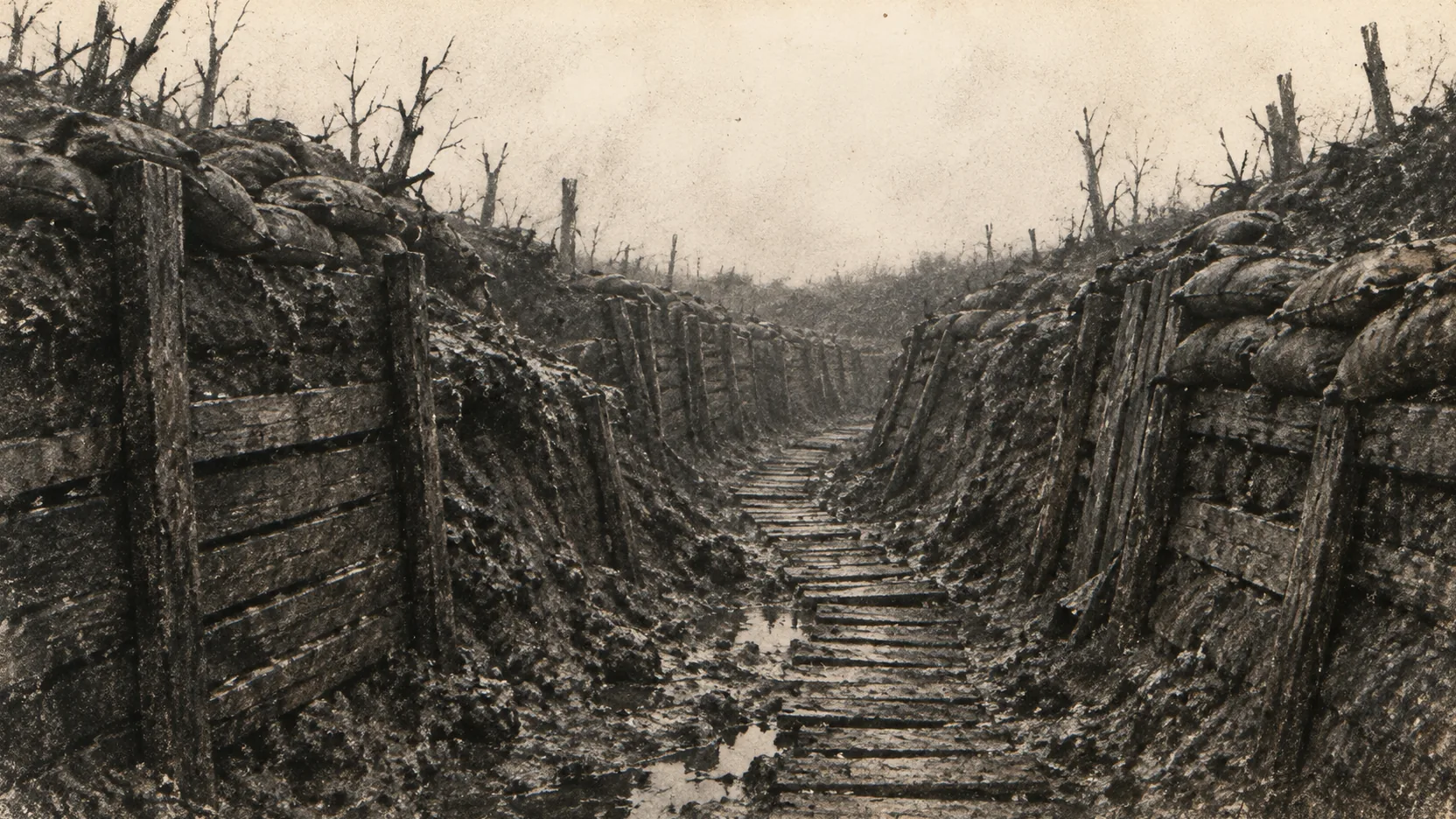
Fierce fighting followed in Flanders (e.g., in the Battles of Ypres until November 11). West of Langemarck inadequately trained German reserve regiments bled to death under British defensive fire. the "heroic death" of German volunteer students and schoolboys became a myth and was especially exploited by the National Socialists, but the hastily formed units were recruited only to a small extent from this group. The fronts now stretched from the North Sea to Alsace. The Western Front froze into trench warfare; repeated Allied attempts to break through in November and December 1914 failed.

While in the West the Germans ultimately achieved only a stalemate in 1914, significant military successes were achieved against the Russians in the first year of the war, for example over the Russian Narew Army at Tannenberg (August 23–31) and the Russian Neman Army at the Masurian Lakes (September 5–15). Thus the Russian offensive in East Prussia was repulsed. These were complete German victories against failing Russian leadership and organization, which established the legendary fame of the military leadership duo Paul von Hindenburg and Erich Ludendorff. The Austrians also initially achieved early successes against the Serbs and Russians, but soon suffered setbacks (the battle for Lemberg, the loss of Galicia and Poland) and required massive German support. Przemysl was besieged by the Russians, relieved by the Germans and Austrians and in November besieged again by the Russians. The Germans formed a 9th Army in Upper Silesia; Hindenburg was appointed Commander-in-Chief East. Under Colonel-General August von Mackensen the 9th German Army took part in operations in Poland (October 3–December 17). Fierce fighting followed in Poland and Galicia; the united Germans and Austrians pushed forward to the Vistula. Battles took place at Warsaw and at Lodz. In November the major Russian offensive against Silesia and Posen began, but the Russian attacks were repelled. In Serbia Belgrade changed hands repeatedly. The fighting in the East and on the Balkans ended in trench warfare.

The naval war began with partial successes of the German East Asia Squadron at Coronel (November 1), but the German overseas cruisers already suffered disaster on December 8 before the Falkland Islands at the hands of British capital ships; only the Emden and the Dresden initially escaped the catastrophe.
The German Mediterranean Division made the run to Constantinople and brought the German ships Goeben and Breslau to the allied Turks. The German fleet suffered an early setback in the North Sea when British ships pushed into the Heligoland Bight and some cruisers and torpedo boats were lost (August 28); however, U-9 succeeded on September 22 in sinking three British armored cruisers.
At the end of 1914 the Germans could not force a decision on any front, but neither could their opponents. However, German plans to end the two-front war quickly on at least one front had failed. Posterity judged especially the outcome of the Battle of the Marne to be decisive for the eventual German defeat.
Recommended Articles

Kriegsgeschichte
The Course of the First World War (1917)
On 19.01. a German alliance offer was made to Mexico. This inevitably led to tensions with North America. On 01.02. Germany announced unrestricted submarine warfare. The demand for such a massive trade war also came from ranks of the Reichstag and put Chancellor Bethmann Hollweg under pressure.

Organisation
The Development of the German Imperial Army in World War I (1914–18) - An Overview
At the outbreak of World War I the Imperial Army comprised 92½ infantry and 11 cavalry divisions with 5,124 field guns and 575 heavy guns.

Kriegsgeschichte
Scenes of War - Tethered Balloon
The use of balloons on the battlefield was already practiced during the Revolutionary Wars.