
Skip to content
Vestes Bellica Military history archive

Vestes Bellica

Scenes of War - Trench Warfare - Firing pits and trenches.

German soldier in a firing pit. Official - undated - original photo.

Whereas a firing pit generally served only one, or at most two, soldiers to protect against enemy action, a trench was a massive form of a sunken field fortification with a firing passage amid forward and rear cover to enable secure firing and protection against bombardment, e.g. by shells.

Developed - consisting of earth-filled wooden revetments - above-ground position. Undated and unlocated original photocard. Around 1914.

After an initial war of movement the Western Front froze into trench warfare following the Battle of the Marne. By autumn 1916 the German trenches in the West measured 700 km in length, 1000 km in the East and 500 km in the South. Multiple lines and communication routes are not included in these figures. Thousands of tons of barbed wire were required every week. Years before World War I a few had the foresight to see what was coming, but they were only lone voices.

Relief moves forward through the approach trench behind the front. Original photocard, undated.

Despite the relevant experiences in the various wars before 1914, the leading military commanders did not want to acknowledge the changed nature of warfare, but continued to espouse antiquated tactical principles. The approach of using ever larger artillery and increasing ammunition consumption to break open the fortress-like positions on both sides and return to mobile warfare did not, at least in the West, succeed.

Above-ground position at the front of the 1st Company of the Infantry Regiment von Goeben (2nd Rhine) No. 28. Undated original photocard. Circa 1914/15. This is still an early, weak fighting trench.
Infantrymen of the 2nd Company of the Infantry Regiment von Goeben (2nd Rhine) No. 28 standing by behind a fortified earthen wall with firing slits. Undated original photocard. Circa 1914/15.
Infantrymen of the 2nd Company of the Infantry Regiment von Goeben (2nd Rhine) No. 28 standing by behind a fortified earthen wall. Undated original photocard. Circa 1914/15.
German soldiers aiming rifles. Behind protective shields in the trench. Undated original photocard.

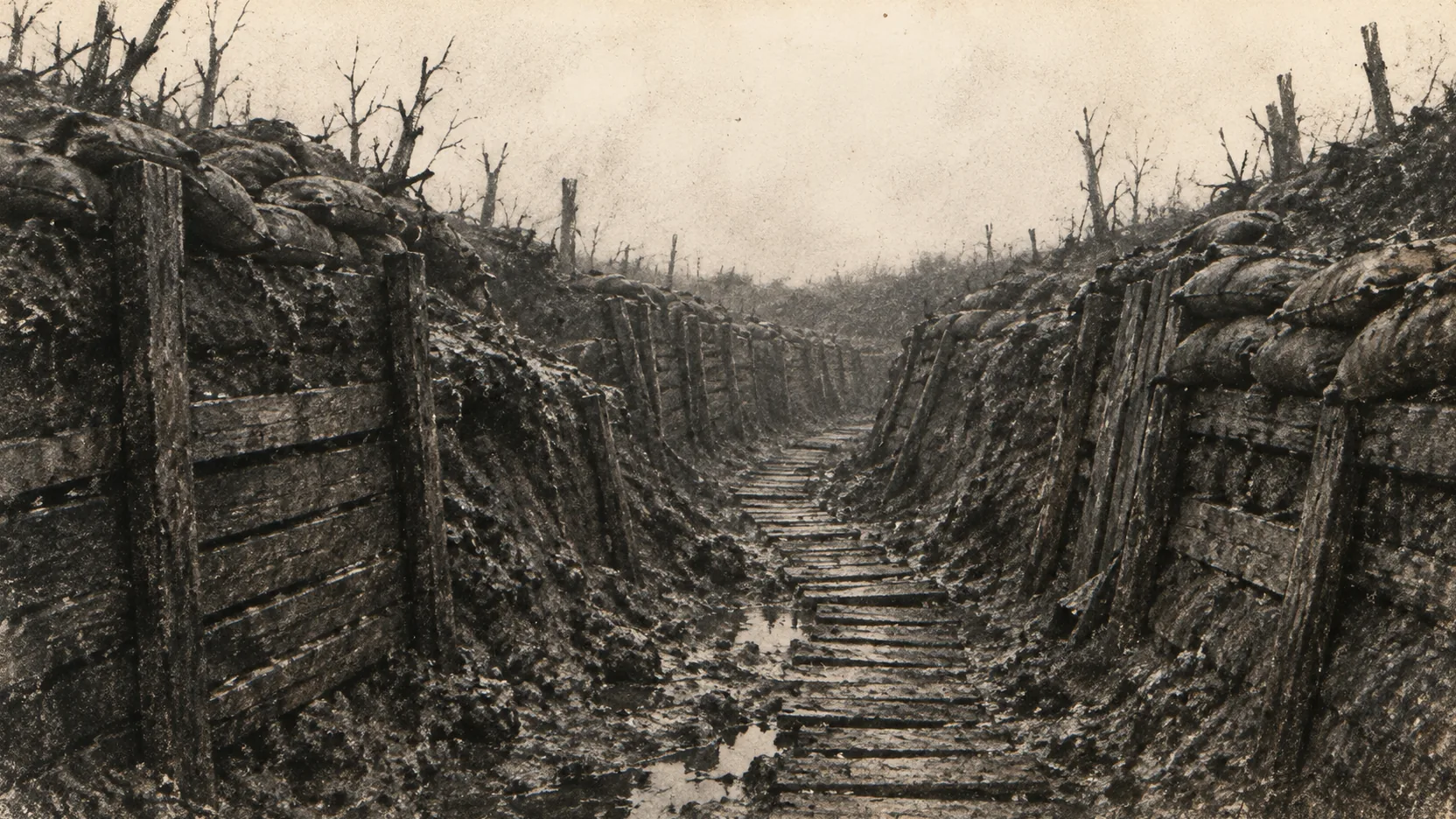
The front in modern trench warfare meant a tangle of wire between the opposing trenches, behind which lay more or less fortified readiness and reserve positions. Firing pits were linked together into trenches, communication trenches connected the front with rear positions. Fortified underground dugouts were constructed for the frontline troops.

In the communication trench. First lieutenant with men. In front, entrance to a dugout. Undated original photocard. Circa 1914/15.

War participant Ernst Jünger reports: "To get to the forward line, briefly called 'the trench', we enter one of the numerous approach paths or communication trenches whose purpose is to enable a covered advance into the fighting position. These often very long trenches therefore lead toward the enemy, but so that they cannot be swept along their length they are laid zigzag or in gentle curves. After a quarter-hour's march we cut the second line, which runs parallel to the first and in which resistance is to be continued if the fighting trench is taken. The fighting trench itself already differs at first glance from the weak works that arose at the beginning of the war. It is no longer a simple ditch, but runs at double or triple man-depth below ground level. The defenders thus move as on the floor of a shaft; when they climb up steps or wide wooden ladders to the posting ledge, a long bench driven into the earth in such a way that the man standing on it protrudes above the surrounding ground to about head height. The individual rifleman stands in his post, a more or less fortified niche, his head covered by a sandbag pack or by a steel shield. The actual outlook is through tiny loopholes through which the rifle barrel is thrust. The large amounts of earth lifted from the trench are piled up behind the line into a bank which at the same time forms rear cover; machine-gun positions are built into this earth bank. On the front face of the trench, however, the earth is always carefully sloped away so that the field of fire remains open...."

In the trench at the 18th Bavarian Infantry Regiment No. 7. Visible among other things is a rifleman in the firing position supported by a spotter with a mirror for observing the enemy front line. In the West. Original photocard, dated: 12.08.1916. Sent the following day.
In the communication trench in front of a dugout. Non‑commissioned officer with privates. The depth of the trench is clearly visible. Original photocard with postmark dated 29.03.1916.
(Saxon) non‑commissioned officers in front of the entrance to a dugout. Original photocard. Back dated: 26.05.1916. Probably not in the immediate front area, perhaps a dugout in the second line.

"... In front of the trench stretches, often in multiple lines, the barbed-wire entanglement, a tangled mesh of wire that is intended to delay the attacker so that he can be fired upon in peace from the post positions. The entanglement is overgrown with tall plants, for a new and different vegetation has already settled on the desolated fields. The wild flowers that previously bloomed scattered among the cereal have gained dominance; here and there low scrub is already sprouting. The paths are already overgrown too, but they are still clearly discernible, for the round leaves of plantain spread out on them. In this wilderness the birds feel at home, such as the partridges, whose strange calling note is often heard at night, and the larks, whose multi-voiced song sounds over the trenches with the first light. So that the fighting trench cannot be fired along its flank, it is run meanderingly; it thus springs back in regular recesses. These recessed sections form the shoulder defenses through which a shot coming from the side is to be absorbed. The fighter is thus covered in the rear by the rear bank, to the sides by the shoulder defenses, while the front wall of the trench protects him as a breastwork...."

Photograph of a position with forward barbed-wire entanglement in winter. Undated original photocard. Circa 1915/16.
Photo of a position in the East. Original photocard circa 1915/1916. In front of the earth fortification the wide forefield with tripwires etc. is clearly visible. According to the inscription on the back, the Russian position cannot be seen from the German position.
Developed position reinforced with sandbags and wickerwork. A standing platform was created for the riflemen/for the defense so that firing could be done from a standing position. The communication trench itself lies deeper. Undated original photo. Not locally assignable.
Developed position with sentry. Original photocard.
Felled tree for the construction of a dugout (at the 2nd Company of IR 53 on the Western Front). Original photocard. Dated: 16.07.1917.
Construction of an officer's dugout. Placed on the rear side of the hill. Original - undated and unsent - photocard.
Construction of a dugout on the Western Front. Original photocard, dated: 12.04.1916.

"... The dugouts are intended for rest; they have developed from simple earth holes into proper enclosed living spaces whose ceilings are built of beams and whose walls are lined with boards. The dugouts are about man-high and are built into the ground so that their floor lies at the level of the trench bottom. Thus a layer of earth still rests over their beam ceiling that can resist light hits. Under heavy fire, however, one sits in the mousetrap and therefore prefers to seek the depth of the gallery. The galleries are clad with strong wooden frames. The first is set into the front trench wall at the level of the bottom and forms the gallery entrance; each further one is placed two hand-breadths deeper so that cover is quickly gained. In this way the gallery stair is formed; at the thirtieth step one therefore has nine, including the trench depth even twelve meters of earth above one's head. Now somewhat larger frames are led straight ahead or at right angles to the stairs; they constitute the living quarters. Through cross-connections underground passageways arise, branches led toward the enemy are used as listening and mining galleries. One must imagine the whole as a mighty, apparently extinct earth fortress lying in the terrain, in whose interior a regular guard and work service is performed and in which, a few seconds after an alarm, every man stands at his post. One should also not imagine the mood too romantically; rather there prevails a certain drowsiness and languor, such as the close contact with the earth produces …"1.

In the front of the communication trench in the sap. Soldier with a hand grenade. Undated original photocard.
Infantryman at the front in a position not yet heavily developed, wearing a steel helmet and a gas mask. Undated original contemporary photo.
Developed entrance to the tunnel. The tunnel stairway is secured with wooden frames. The visible sign provides information about the maximum occupancy of the dugout. The original photocard dated 26.09.1916. The sender belonged to the 5th Company of Reserve Infantry Regiment No. 73.
Entrance to the dugout of the 8th Lorraine Infantry Regiment No. 159 with two levels. Below, a captain wearing a field cap with concealed piping and the Iron Cross 2nd Class. Original undated photocard.
Trench with the accesses to the underground dugouts in the Somme area. Original photo from the year 1916.
Position of Reserve Infantry Regiment No. 225. Original photocard, posted on 10.10.1916.
In a fortified position on the Eastern Front (Beresina). Original photocard. Not dated.

The trench system, however, was not uniform; it varied from sector to sector. Due to the extremely low groundwater, construction of positions in Flanders was particularly arduous and therefore mostly took place above ground.

Above-ground dugout at Hollebeke in Flanders. Circa 1914/15. Original photocard.
Above-ground position in the 1st line, likely in the West. Due to weather and groundwater the soldiers regularly had to contend with water. Original photocard, dated: 10.10.1917.

A contemporary account reads: "The next morning we stood with wet, freezing feet in the rain at the gun. Then the whole desolation of the situation came to our awareness. Everything around was flooded. Water up to the edge in the trenches, water in the dugouts, rain from above, mud and water from below. No opportunity to sleep, no opportunity to cook. Oh, how we longed for some coffee! Well, first we had to pave a way between the guns out of the stones of the burned farmstead. And it rained! Afterwards we sat crowded in the dugout and no longer had the courage, as necessary as it was, to start building a new dugout that day. Toward evening our cook brought a pot of food that he had cooked far away in some house. Then life returned among us. The second night we slept again on shell baskets. The next morning it was fine weather, so we went to our dugout. We dug out at as dry a spot as possible and built walls of turf. We worked joyfully and industriously until it got dark. The next morning — oh horror — it rained again! Our new dugout already had water. What to do? We waited until noon, then the rain stopped, and we worked on. We almost got the water out. It became evening again, and we were not finished. The next morning there was water in the new build again. Knee-deep, and the walls had partly collapsed. So we went to a new dugout. We built it on level ground and worked like lions. We hauled tree trunks from abandoned trenches and from far in the woods. We had to cross a field that looked like a frying pan: hole after hole and duds, blowouts, shell fragments, and every hole filled to the brim with water. In the evening we were finished. Then we had a dry, rainproof sleeping place. Today it already looks quite cozy inside," wrote the artilleryman Hans Olde in a letter dated 07.12.1914 (Bixschotte-Langemark).

Württemberg infantry in the trench on the Western Front. This is the 1st firing line. The professional wooden construction is evident, also secured by crossbeams. Original photocard. Dated: 05.05.1916.
Example of a heavily developed trench with various levels and - according to the inscription on the original - undated photocard - also equipped with concrete dugouts. The type of fortification construction changed over time and reacted to the increased heavy enemy bombardment, e.g. by mortars. The tunnel stairways now reached - for example in the area of the Battle of the Somme - in places 6-8 m into the subsoil. The dugouts lay 8-12 m below the surface. The tunnel stairways no longer led directly to the dugouts, but there were multiple entrances, also from the side. Thus the soldiers there could no longer be enclosed so easily. In the aforementioned area there were also huge underground fortresses. Photo 1916/17.
Lightly developed position in the second line. Original photocard.
Rear approach trench in a woodland position. Original photographic postcard. The communication trench is not very deep, so probably not visible to the enemy or located further back.
Position in winter in the East (possibly on the Düna). Original photographic postcard.

Recommended Articles

Kriegsgeschichte

The Course of the First World War (1918)

The beginning of 1918 was marked by peace efforts, in particular the message of American President Wilson which set out a peace program of 14 points. In Austria and Germany mass strikes alarmed the political and military leadership. The American peace initiative was commented on in varying ways on the German side, but ultimately found no positive echo among the Central Powers. At that time the Allied side was also not really willing to negotiate. Between late October and mid-February peace negotiations between Russia and the Central Powers took place in Brest-Litovsk. The peace terms offered were harsh. The Russian negotiator Trotsky announced the demobilization of the Russian army but did not want to accept the conditions set by the Germans. Thereupon military hostilities flared up again and German troops advanced further into Russian territory. In February Reval, Minsk and Zhytomyr and in March Kiev were occupied. On 03.03. a formal peace was concluded after all, since the Russian empire, destabilized by the revolution, urgently needed peace. Already on 09.02. a peace had been concluded with Ukraine. This freed Germany from a two-front war and allowed it to reinforce the Western Front with troops no longer needed in the East, yet the presence of the Central Powers in the politically restless eastern regions was still required as a protecting power.