
The Course of the First World War (1917)

The War Year 1917
On 19.01. a German alliance offer was made to Mexico. This inevitably led to tensions with North America. On 01.02. Germany announced unrestricted submarine warfare. The demand for such a massive trade war also came from ranks of the Reichstag and put Chancellor Bethmann Hollweg under pressure.

The aim was above all to exhaust Britain within a few months, and that before the expected entry of North America into the war in Europe took effect. The German Admiralty calculated a monthly sinking figure of 600,000 tons as necessary. 105 submarines were available for this. The decision for unrestricted submarine warfare implied the near-certain risk of war with North America, and that is what happened. Already on 03.02. diplomatic relations between Germany and the USA were broken off. On 06.04. the American declaration of war followed. Although the German submarines operated successfully - they sank a total of 6,141,000 BRT in the period from 01.02. to 31.12.1917 – the High Command's last card did not win; the predicted collapse of British resistance did not occur.

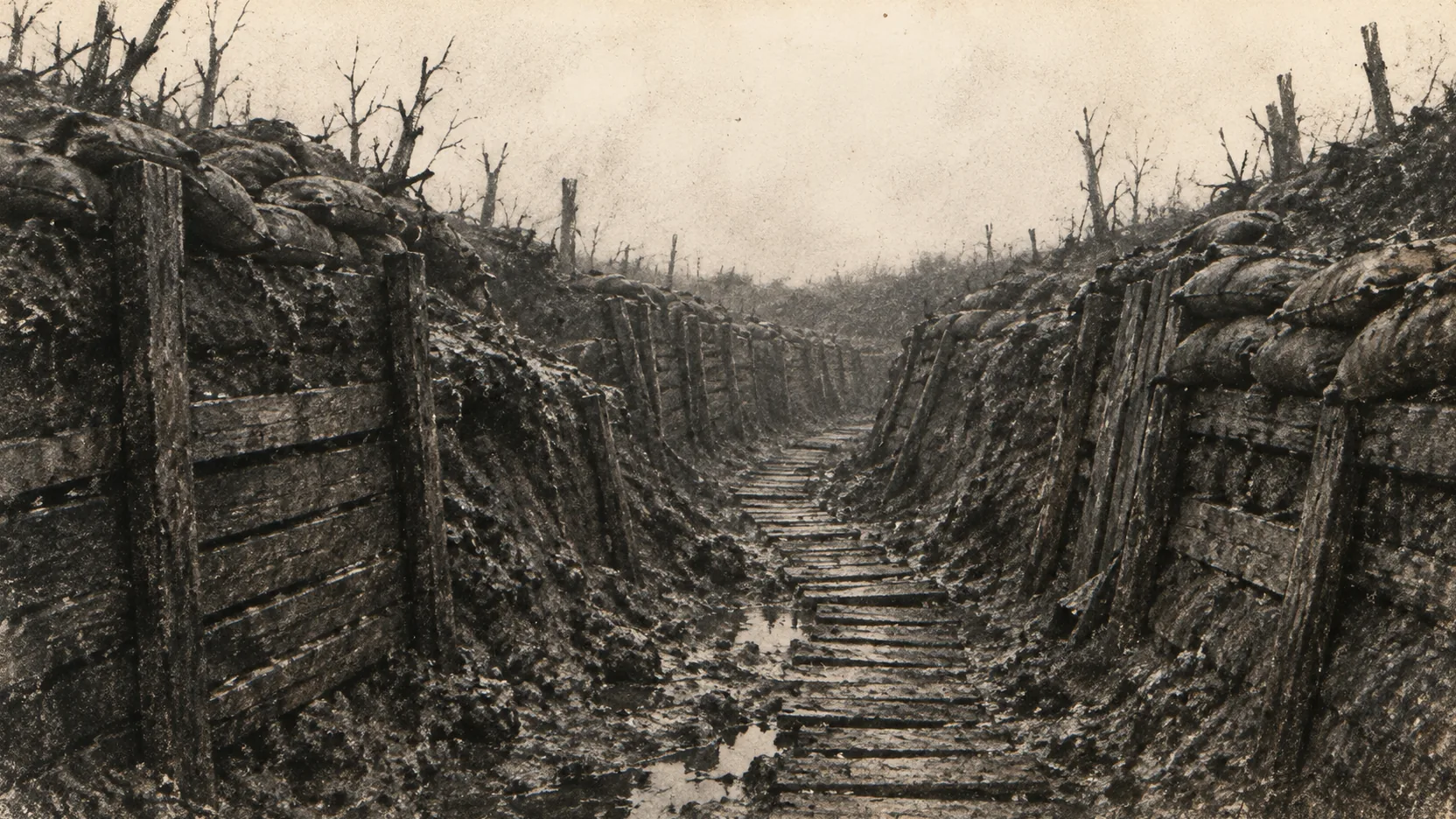
In the West the new military leadership duo Hindenburg/Ludendorff surprised the opponents by withdrawing the German front back to the fortified Siegfried position between Arras and Soissons. This shortened the front by about 170 km and the front-line troops moved from adverse conditions in the poorly constructed and waterlogged trenches to good permanent positions. The abandoned terrain was systematically destroyed. The withdrawal did not undermine the fighting morale of the German soldiers because of their confidence in the new military leadership. The British and French reacted hesitantly to the German repositioning, but then tried to achieve a breakthrough with mass assaults, for example from 02.04. in the Artois, from 16.04. on the Aisne, from 07.05. at the Winterberg, etc., and from 09.05. in the Champagne. The French attacks were bloodily repulsed, and there were widespread mutinies in the French army. For a certain period it was no longer operational. The British attacks, especially in Flanders, also failed or achieved only partial successes, for instance in the tank battle at Cambrai from 20.11. to 05.12. As early as 15.09.1915 the British army had used tanks (= armoured vehicles) for the first time in the Battle of the Somme (49), thereby introducing a new weapon category to the battlefield. It would revolutionize warfare, although the initial deployment did not necessarily suggest such a consequence. The German units affected were initially powerless against the new weapon, but only 32 British tanks had even reached the combat area. Nine tanks were knocked out after the initial shock, partly by direct artillery fire. Some tanks became stuck in shell craters, some suffered engine failures; only nine tanks returned from the first tank attack in the history of warfare to their starting positions. On 20.11.1917 the British tank arm was more successful; this time 400 tanks were involved. Large penetrations into the “Siegfried Position” were achieved, which the Germans could only seal off with great effort. Despite the successful repulsion of the tank attack, its initial successes had shown the British leadership that breaking open the fronts frozen for years in positional warfare by mass tank attacks had become possible. German reserve units, however, prevented a disaster, and in a counter-offensive from 30.11. almost all the lost terrain could be retaken.


The last major British attacks in Flanders took place in October and November; at the same time the French attempted relief attacks before Verdun, at the Chemin des Dames and at the Laffaux corner. The new French high command – General Pétain had replaced General Nivelle at the end of May – had overcome the existential crisis in the French army.

On the Italian front the German-Austrian 14th Army under General Otto von Below achieved a breakthrough at Flitsch and Tolmein; the Italians were forced to retreat behind the Piave. The pursuit ended there. General Diaz, with the support of the British and French and as successor to the defeated General Cadorna, organized the resistance. As a result, the Allies finally established a joint high command to coordinate military efforts. The Italians had 40,000 casualties, 2,650,000 prisoners and lost about 3,000 guns; nevertheless, it was again possible to internally consolidate the Italian army. The fifth year of the war was to bring disaster for the Austrians; their army had long only been able to bear the burdens of war with massive German support.

The Eastern and Balkan fronts saw pursuit fights against the Romanians in eastern Wallachia in January; on 04.01. Brăila was occupied. From February, however, the Eastern Front became calmer for months because of the Russian Revolution. The Tsar abdicated on 02.03., but the subsequent provisional bourgeois government and the later coalition governments under A. F. Kerensky wanted to continue fighting the Central Powers. Therefore further fighting took place on the Russian Southwestern Front and in eastern Galicia. On 03.09. German troops occupied Riga.


In October the Baltic islands Ösel, Moon and Dagö were occupied in the course of the largest landing operation to date with about 23,000 men and 3,000 horses. It was a successful joint operation of navy and army. With Germany's approval Lenin moved from Swiss exile to Russia and intervened – as planned by Germany – decisively in the domestic power struggles. While on 03 and 04.07. the acting government under Kerensky still had opposition demonstrations in Petrograd shot down, in the so-called October Revolution the Bolsheviks seized power. Lenin then assumed power as Chairman of the Council of People's Commissars. In Russia the supply situation was catastrophic; the Bolsheviks wanted to end the war. On 15.12. a ceasefire between Russia and the Central Powers came into effect for a period of 28 days; on 22.12. corresponding peace negotiations began.

In the Middle East the German-Turkish troops were in retreat; on 09.12. the British occupied Jerusalem.

The remnants of the German Schutztruppe marched under Lettow-Vorbeck through Portuguese East Africa (November to September 1918). The fighting in the Orient and in Africa, however, were only insignificant secondary theaters of war.

In Germany domestic political conflicts increased in 1917; in April there were mass strikes. The SPD had split in Gotha on 09.11.04. The result was a further radicalization of German domestic politics. On 13.07., under pressure from the military leadership, Chancellor Bethmann Hollweg was replaced by Dr. Michaelis; he was already succeeded on 01.11. by the Bavarian Minister-President Georg Graf von Hertling as the new Chancellor. The threatening domestic political development in Russia and the growing dissatisfaction among the population motivated belated political reforms. These were intended to prepare parliamentarism and to transform the authoritarian state into a people's state. However, they were only half-hearted attempts. The Reichstag voted on a peace resolution presented by Centre Party deputy Matthias Erzberger, which explicitly renounced territorial conquests. The military leadership reacted to the declaration, which was adopted by a majority, with outrage.
Recommended Articles

Kriegsgeschichte
Scenes of War - Prisoners
A certain share of the respective losses were prisoners: for the French about 12%, for the Germans about 9%, and for the British about 7%; the Austro-Hungarians and the Russians had significantly higher prisoner rates (35% and 50%, respectively).

Organisation
The German Imperial Army in the World War - Structure and Organization - Fortification Troops
As early as mobilization, so-called fortification troops were planned. These were to carry out the necessary earthworks in the course of strengthening the fortresses.

Organisation
The German Imperial Army in the World War - Structure and Organization - Military Chaplains
Even in peacetime religious care was provided.