
Archive for this collection
Explore articles
29 contributions in the archive
Loading results …
The results could not be loaded. Please try again.
42 articles found

Kriegsgeschichte
Scenes of War - Mine and Grenade Launchers
The first mine launchers were already designed before the outbreak of the war. They were usually smoothbore high‑angle firing weapons that fired shells and were primarily intended for fortress warfare. Compared with the usual guns they had only a short range and were therefore meant primarily for close combat. Mine launchers were used for the first time during the siege of Port Arthur in 1904.

Kriegsgeschichte
Scenes of War - Soldiers and Guns
At the beginning of the war artillery was still regarded as an auxiliary weapon, but developments quickly showed that this was an outdated tactical approach.

Organisation
The German Imperial Army in the World War - Structure and Organization - Motor Vehicle Troops
After mobilization the German Army had about 4,000 motor vehicles and motorized wheels as well as tractors. Motorization was, however, only rudimentary. Even in peacetime the military leadership had at least dealt with the truck service, but only a limited number were acquired for military purposes before 1914. In addition, truck manufacturing was regulated and purchases were promoted by granting state loans; in case of war civilian vehicles were to be requisitioned. During the war vehicle production was strongly stimulated, and special trucks with anti-balloon guns and tractors for the artillery or for ammunition transport were also developed.

Organisation
The German Imperial Army in the World War - Structure and Organization - Engineers
During the First World War the engineer arm experienced an unforeseen rise in importance and, as the daily reality of war increasingly resembled that of fortress warfare, became an important support arm for the infantry.

Organisation
The German Imperial Army in the World War - Structure and Organization - Machine Gun Companies/ - Detachments
At the outbreak of the war the German Army had 360 machine-gun companies/detachments; by the end of 1915 there were already 450. In addition, at that time there were 80 machine-gun platoons with the cavalry. The number of machine guns was, however, continuously increased. In the autumn of 1916 it was ordered that henceforth each infantry battalion was to have 1 and each Jäger and storm (assault) battalion 2 machine-gun companies. At the same time additional machine-gun sharpshooter detachments (each of 3 companies) were formed.

Organisation
The German Imperial Army in the World War - Structure and Organization - Bicycle Troops
The cyclist companies formed in 1913 were assigned as the 6th company to the Jäger and Schützen battalions. In September 1914 a second cyclist company was allotted to each battalion. Numerous cyclist units were also formed later. The cyclists did not have replacement companies, but the reserve battalions of the Jäger and Schützen had corresponding cyclist detachments.

Heeressoziologie
Scenes of War - Hygiene
In peacetime, medical and nursing care was the responsibility of the medical officers, who were supported by orderlies. To prevent contagious diseases as far as possible, the living quarters in the barracks had to be inspected regularly, as did the drinking water and the food supplies. The troops were to be examined for their fitness before the start of longer marches – e.g., during maneuvers. The barracks had regimental sickrooms, and there were military hospitals in the garrisons. Convalescent homes were established for non-commissioned officers and enlisted men in the various army corps. Wartime brought different conditions, yet the medical service of the German army was comparatively advanced. From 1914–18 comparatively few German soldiers fell victim to epidemics; in the war it is said that 21 German soldiers died of smallpox, 11723 of typhus, 8646 of dysentery, 1693 of cholera, 452 of malaria, 999 of influenza, and 1345 of typhus exanthematicus (spotted fever).

Kriegsgeschichte
Outbreak of the First World War and the German Mobilization
Arms buildups and mutual distrust created, at the beginning of the 20th century, a climate in which a spark could trigger an explosion. The First World War had increasingly become a certainty in the years before 1914. The decisive trigger ultimately proved to be an act of blood on the Balkans. On 28.06.1914 the Austrian heir to the throne, Archduke Franz Ferdinand, and his wife were assassinated in Sarajevo. The background to this assassination was the Slavonic aspirations for freedom within the borders of the moribund Danube Monarchy.

Kriegsgeschichte
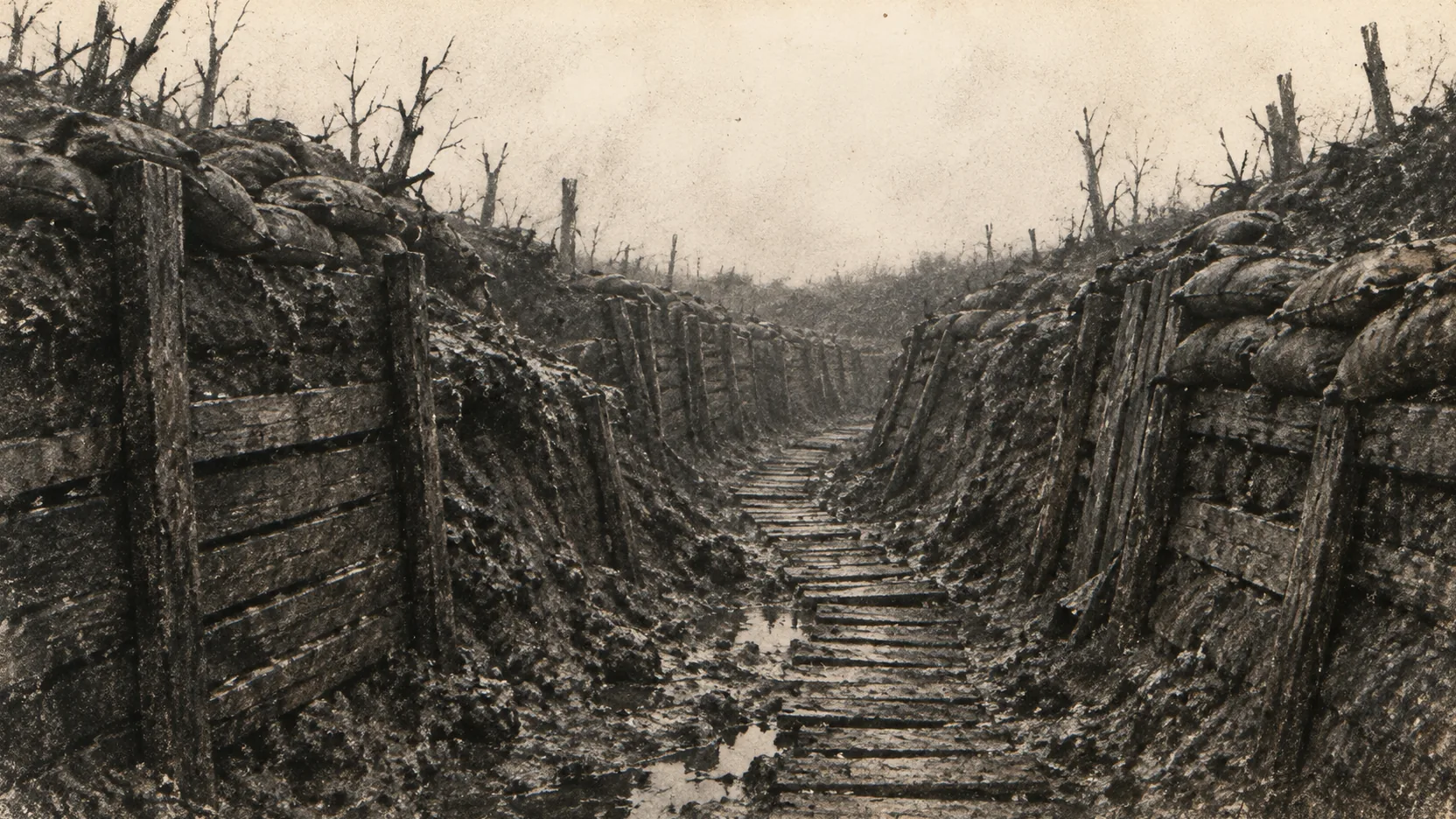
Scenes of War - Trench Warfare - Firing pits and trenches.
Whereas a firing pit generally served only one, or at most two, soldiers to protect against enemy action, a trench was a massive form of a sunken field fortification with a firing passage amid forward and rear cover to enable secure firing and protection against bombardment, e.g. by shells.

Uniformierung & Ausrüstung
The German Imperial Army in the World War - Uniforms and Equipment - Headgear - Steel Helmet
But the most conspicuous change was the introduction of the steel helmet in 1916, which replaced the classic Pickelhaube.

Kriegsgeschichte
Scenes of War - German Submarines
The first German U-boat was commissioned in 1906.

Kriegsgeschichte
Scenes of the War - abandoned or destroyed British tanks
The British tanks were various models, called Mark I-V. These tanks measured 8 m in length and weighed 28 t. With 150 hp they reached a maximum speed of 7.4 km/h.