
Archive for this collection
Explore articles
29 contributions in the archive
Loading results …
The results could not be loaded. Please try again.
25 articles found

Kriegsgeschichte
The Flanders Corps. Photographic estate.

Kriegsgeschichte
Prisoners - The Return of German Prisoners of War from Japan in the Years after 1918
Kiautschou Bay was taken into possession by the German Reich on November 14, 1897. Early on this area had been identified as a suitable trading base.

Kriegsgeschichte
Scenes of War - Mine and Grenade Launchers
The first mine launchers were already designed before the outbreak of the war. They were usually smoothbore high‑angle firing weapons that fired shells and were primarily intended for fortress warfare. Compared with the usual guns they had only a short range and were therefore meant primarily for close combat. Mine launchers were used for the first time during the siege of Port Arthur in 1904.

Kriegsgeschichte
Scenes of War - Soldiers and Guns
At the beginning of the war artillery was still regarded as an auxiliary weapon, but developments quickly showed that this was an outdated tactical approach.

Kriegsgeschichte
Outbreak of the First World War and the German Mobilization
Arms buildups and mutual distrust created, at the beginning of the 20th century, a climate in which a spark could trigger an explosion. The First World War had increasingly become a certainty in the years before 1914. The decisive trigger ultimately proved to be an act of blood on the Balkans. On 28.06.1914 the Austrian heir to the throne, Archduke Franz Ferdinand, and his wife were assassinated in Sarajevo. The background to this assassination was the Slavonic aspirations for freedom within the borders of the moribund Danube Monarchy.

Kriegsgeschichte
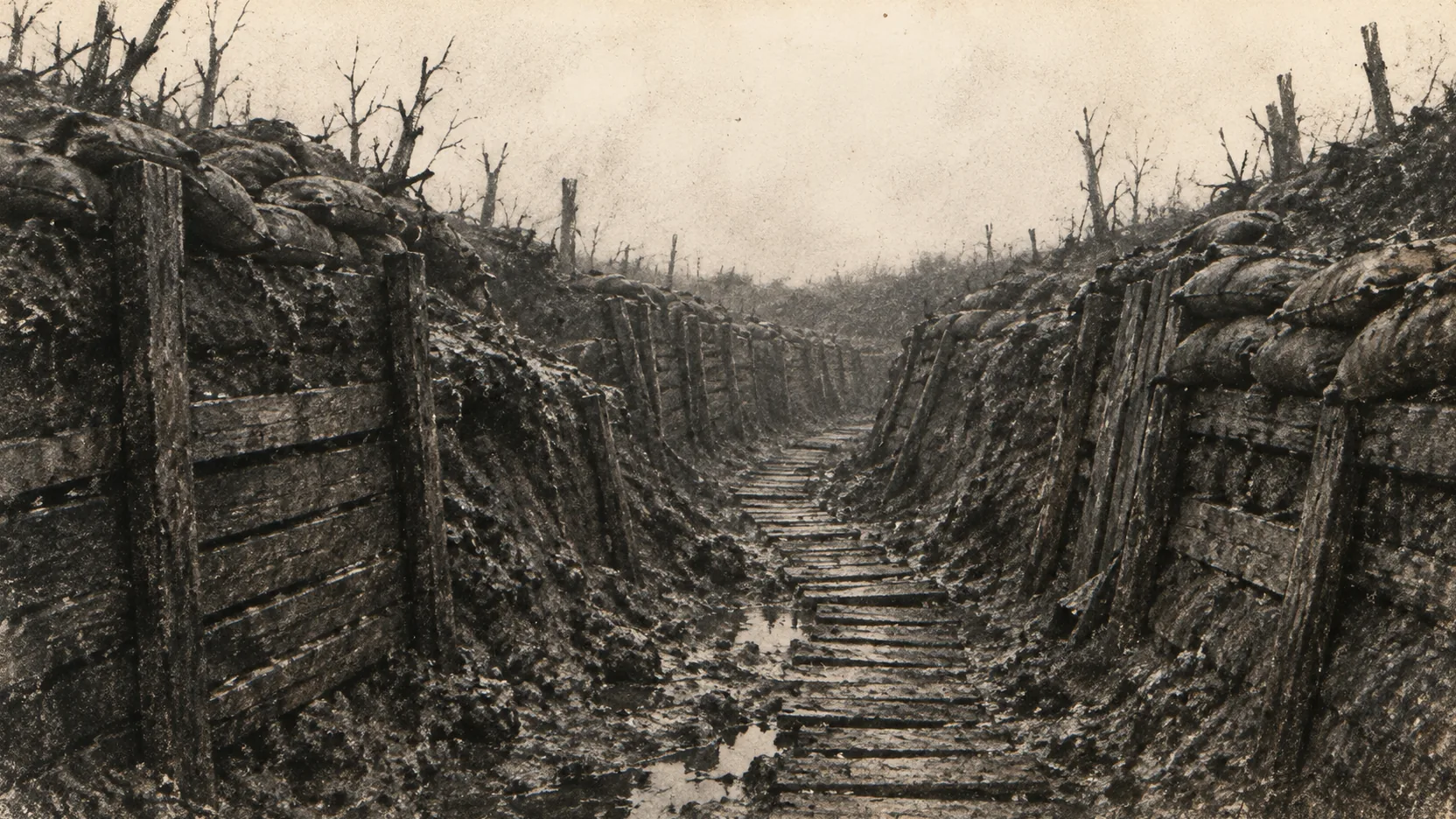
Scenes of War - Trench Warfare - Firing pits and trenches.
Whereas a firing pit generally served only one, or at most two, soldiers to protect against enemy action, a trench was a massive form of a sunken field fortification with a firing passage amid forward and rear cover to enable secure firing and protection against bombardment, e.g. by shells.

Kriegsgeschichte
Scenes of War - German Submarines
The first German U-boat was commissioned in 1906.

Kriegsgeschichte
Scenes of the War - abandoned or destroyed British tanks
The British tanks were various models, called Mark I-V. These tanks measured 8 m in length and weighed 28 t. With 150 hp they reached a maximum speed of 7.4 km/h.

Kriegsgeschichte
Scenes of War - Tethered Balloon
The use of balloons on the battlefield was already practiced during the Revolutionary Wars.

Kriegsgeschichte
Scenes of War - Soldiers' Provisions
The German army in the field had an enormous need for provisions; the weekly requirement for staple foods was reported as follows: 27,085,000 kg of bread, 59,485,000 kg of potatoes, 7,913,500 kg of meat, as well as 904,600 kg of salt, 614,800 kg of sugar and 900,600 kg of coffee. In addition there was demand for fat, oats, hay and straw. Analogous to the nutrition and supply problems at home — where rationing of all important foods had already begun in autumn 1915 — the supply base at the front also became increasingly meager.

Kriegsgeschichte
Scenes of War - captured or destroyed French tanks
Undated original photo. Probably a French tank of the "Schneider" type. It had a length of 6 m, 70 hp and reached a maximum speed of 8 km/h. The crew consisted of 6-7 men, the armament of a 7.5 cm gun and two machine guns.

Kriegsgeschichte
Scenes of War - Prisoners
A certain share of the respective losses were prisoners: for the French about 12%, for the Germans about 9%, and for the British about 7%; the Austro-Hungarians and the Russians had significantly higher prisoner rates (35% and 50%, respectively).