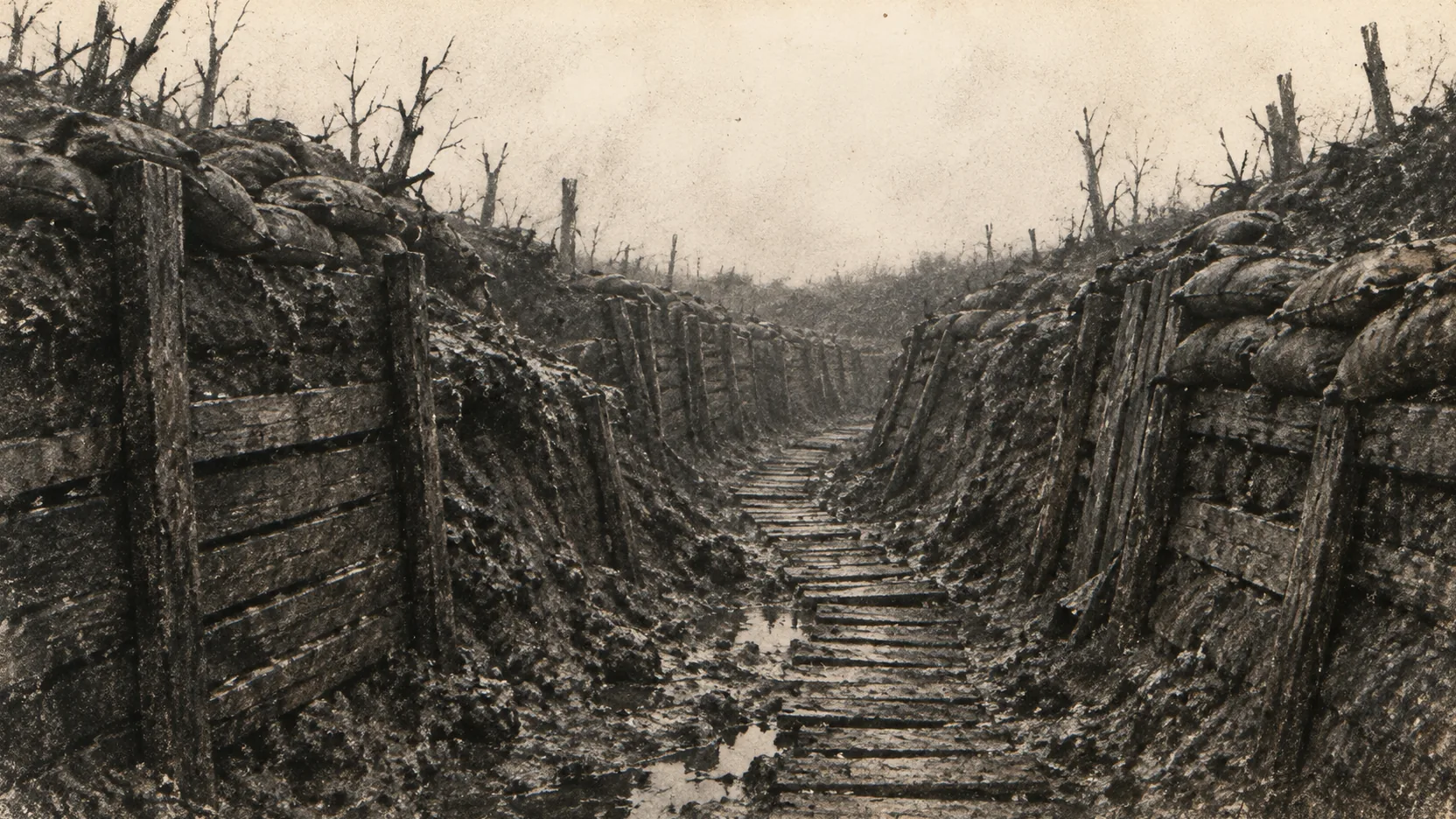

Scenes of War - Mine and Grenade Launchers

The first mine launchers were already designed before the outbreak of the war. They were usually smoothbore high‑angle firing weapons that fired shells and were primarily intended for fortress warfare. Compared with the usual guns they had only a short range and were therefore meant primarily for close combat. Mine launchers were used for the first time during the siege of Port Arthur in 1904.

The mine launcher was a throwing gun designed to destroy resistant or otherwise hard-to-hit obstacles and targets, such as gun positions, machine‑gun positions, or armored observation posts.
The first German models were heavy and medium mine launchers that could hurl shells or mines roughly 400 m and 759 m, respectively. The heavy mine launcher fired projectiles weighing 97 kg. The medium mine launcher was loaded with projectiles weighing 51 kg. The smaller projectiles for light mine launchers weighed 4.5 kg.

Basically the mine launcher followed the principle of the mortar. They were muzzle‑loaders, although larger calibers were arranged as breech‑loaders.
In trench warfare the importance of this weapon quickly became clear; in particular, light and thus more easily transportable mine launchers with a range of up to 1000 m acquired a significant role in infantry combat. With them the enemy could be struck behind cover.

At the beginning of the war there were 70 heavy and 110 medium mine launchers in the engineer parks. Later the aforementioned light mine launchers were designed and further developed. The mine‑launcher units were constantly increased. Initially they belonged to the engineer branch.

Each pioneer battalion received a mine‑launcher company; as the force was further expanded, each infantry, Jäger (light infantry), or rifle battalion then received four light launchers. Only the heavy and medium mine launchers remained divisional troops. The latter were still operated by engineers, while the light mine launchers became exclusively an infantry weapon.

Ultimately there were 23 mine‑launcher battalions, 250 mine‑launcher companies and 580 mine‑launcher detachments. In total there were 17,000 mine launchers.


Recommended Articles

Kriegsgeschichte
Scenes of War - Marches
Figure above: Soldiers on the march. Photo: W. Braemer/ Berlin. Around 1914/15.

Kriegsgeschichte
Prisoners - The Return of German Prisoners of War from Japan in the Years after 1918
Kiautschou Bay was taken into possession by the German Reich on November 14, 1897. Early on this area had been identified as a suitable trading base.

Kriegsgeschichte
Scenes of War - German Submarines
The first German U-boat was commissioned in 1906.