
Infantry Regiment Herwarth von Bittenfeld (1st Westphalian) No. 13
The units of the Royal Prussian garrison at Münster
Almost all branches of the armed forces were also represented in the garrison at Münster. Some formations were particularly closely associated with the city of Münster as their garrison, namely: the Infantry Regiment Herwarth von Bittenfeld (1st Westphalian) No. 13, the 2nd Westphalian Field Artillery Regiment No. 22, and the Westphalian Train Battalion No. 7. While the Infantry Regiment Herwarth von Bittenfeld (1st Westphalian) No. 13 enjoyed great popularity especially among the urban bourgeoisie, the Westphalian nobility served in the Cuirassier Regiment von Driesen (Westphalian) No. 4 and the replacement recruits came in particular from the rural milieu.
On the origins and development of IR 13
The Infantry Regiment Herwarth von Bittenfeld (1st Westphalian) No. 13 was formed in the context of the strengthening of the new Prussian army during the Wars of Liberation and was constituted from four newly established battalions, namely from the III Battalion of the 1st East Prussian Infantry Regiment, the 1st and 2nd East Prussian Reserve Musketeer Battalions, and the 1st Lithuanian Reserve Fusilier Battalion.
Over time the regiment bore various designations:
from 1813 1st Reserve Infantry Regiment
from 1815 13th Infantry Regiment
from 1816 13th Infantry Regiment (1st Westphalian)
from 1860 1st Westphalian Infantry Regiment No. 13
from 1889 Infantry Regiment Herwarth von Bittenfeld (1st Westphalian) No. 13.


In 1866 IR 13 transferred companies No. 13, 14 and 15 to IR 85.
In 1881 IR 13 transferred the 7th Company to IR 131.


The 100-year celebration in 1913 (founding festival)
The unit's foundation day is considered to be 01.07.1813.
The centenary celebration of the foundation day took place from 02–04.07.1913 in Münster.
Members of the Herwarth v. Bittenfeld family were also present at the celebration as officers.


Organizational placement of IR 13 in the Imperial Army
From 1856 IR 13 was assigned as follows:
VII Army Corps (Münster)
13th Division (Münster)
25th Infantry Brigade (Münster)

The patrons (Inhaber) of IR 13 over time
The chiefs of IR 13 were:
1842 - 49: General of the Infantry Ernst v. Pfuel (commanding general of the VII Army Corps)
1851 - 1853: Grand Duke Friedrich August of Oldenburg (General of the Infantry; he died already on 27.02.1853)
1861 - 1884: Field Marshal Eberhard v. Herwarth v. Bittenfeld
1892 - 1896: Duke Wilhelm of Württemberg
1897: v. Blume
1898: von Blankenburg.

The position of regimental chief was merely honorary.
The respective commander regulated and supervised the uniformity of training. He held disciplinary authority and lower jurisdiction. Furthermore, the regimental commander was responsible for the allocation of replacements for men and horses, the promotion and dismissal of the ranks, as well as the replenishment, maintenance and storage of clothing and equipment.
The officer corps was subordinate to him; he prepared the evaluations of the officers and presided over their honor courts.
To fulfill his duties a staff was attached to the regimental commander.
The commanders of IR 13 over time
The regimental commanders of IR 13 over time were:
from 1813: Langen, Karl von
from 1815: Quadt und Hüchtenbruck, Konstantin von
from 1815: Ledebur, Alexander von
from 1830: Natzmer, Wilhelm von
from 1836: Björnstjerna, Gustav Heinrich von
from 1841: Klein, Philipp
from 1847: Schröders, Karl
from 1850: Roedern, Louis von
from 1855: Mülbe, Otto von der
from 1857: Plessen, Hermann von
from 1858: Ingersleben, Albert von
from 1861: Witzleben, August von
from 1865: Gellhorn, Paul von
from 1867: Goetzen, Louis von
from 1868: Barby, Rudolf von
from 1869: Frankenberg und Ludwigsdorf, Moritz von
from 1873: Dallmer, Leopold von
from 1879: Schaumann, Karl von
from 1885: Specht, Wilhelm von
from 1888: Alvensleben, Friedrich von
from 1891: Warendorff, Heinrich von
from 1894: Hentschel von Gilgenheimb, Leopold
from 1896: Fransecky, Heinrich von
from 1897: Blankenburg, Hermann von
from 1899: Schack, Hans von
from 1902: Brozowski, Wilhelm von
from 1905: Rosenberg-Gruszczynski, Horst von
from 1909: Homeyer, Otto von
from 1912: Ziegesar, Hermann von
from 1914: Delius, Hermann
from 1915: Gross, Carl

The locations and the recruitment area of IR 13
The Westphalian stations were reached in mid-1817.
From 1877 the unit's peacetime garrison was solely Münster.
Previously parts of the formation were also stationed alternately in Soest, Wesel and Paderborn; for example, from 1817 - 1851 the staff and the I Battalion were garrisoned in Münster, while the II Battalion was in the fortress of Wesel.
In the years 1851 - 1856 the regiment was even entirely assembled in Wesel.
The replacement recruits were provided to the regiment until 1817 from East Prussia, and after 1817 from Westphalia, namely from the area around Münster, Soest and Wesel.


On the war history of IR 13 (exclusively of the First World War)
The unit took part in various campaigns and engagements as well as other deployments:
1813 - 15: 1813 Großbeeren, Dennewitz, 1814 Wittenberg. 1815 Landau
1849 (May): Detachment of 100 men to suppress the revolt in Iserlohn
1864: Missunde (02.02., only fusilier battalion), Düppel (18.04, assault on the entrenchments), Als (29.06, crossing)
In this campaign the regiment suffered fatalities of: 1 officer, 11 non-commissioned officers and rank-and-file. 3 officers, 58 non-commissioned officers and privates were wounded.
1866: Kissingen, Lausach, Aschaffenburg.
In this campaign 5 officers and 16 non-commissioned officers and privates were killed. 6 officers and 85 non-commissioned officers and privates were wounded; 2 soldiers were reported missing.
1870: Colombey, Gravelotte, Villers l’Orme, Peltre and Mercy-le-Haut, Auxerre and St. Bris, Precy and Vorges, Siege of Metz
In the military conflict with France IR 13 lost a total of 7 officers. Furthermore, 106 non-commissioned officers and privates were killed, 306 were wounded.

On the organization and establishment strength of IR 13
Like every infantry regiment, the unit consisted of 3 battalions, each comprising 3 companies and 1 machine gun company.
In peacetime the machine gun companies and detachments each had 6 guns and 3 ammunition wagons.
At the mobilization of 1864 the regiment numbered according to Klüting: 68 officers, 183 non-commissioned officers, 2,217 rank-and-file, 12 hospital assistants, 69 train drivers, totaling 2,549.
2 infantry regiments formed a brigade.
2 brigades formed a division.
The staff of an infantry regiment included the following officers: 1 commander, 1 lieutenant colonel, 3 (junior) majors and 1 adjutant. The battalion comprised 4 companies (infantry and light infantry).
The battalion commander was responsible for the discipline and training of his unit and for the good condition of clothing and equipment. He also prepared evaluations of his officers, etc. Where it concerned an independent battalion, e.g. among the light infantry, he had additional powers similar to a regimental commander.
The company was commanded by a captain.
He was responsible for training the unit in all branches of service and, within his area of responsibility, for discipline, the supplementation and training of the non-commissioned officers and the state of clothing and equipment. He was supported in his duties by the junior officers.
The officer corps of IR 13 in 1870/71 (not all pictured). The photos come from a private photo album of Sec. Lt. Hermann Leesemann. He is named in the officer postings on 01.08.1870 as adjutant of the fusilier battalion of IR 13. Parts of the correspondence from the campaign in France have also been preserved, e.g. to his sister and his father in Münster.


The Officer Corps
Officers were recruited from former cadets or young men who entered the regiments directly as officer cadets (Fahnenjunker). They had to possess a certain level of education and, if medically fit, be between 17 and 23 years old. Acceptance was carried out by the regimental commanders. Academic qualification could also be demonstrated by a so-called Fähnrich examination before the Upper Examination Commission in Berlin. After training and attendance at the war school they had to take a regular officer examination before the aforementioned Upper Examination Commission and could then, after election by the respective officer corps, be proposed for promotion to lieutenant. In the cavalry, and especially in its particularly aristocratic (guard) regiments, descendants of noble families in particular served. In Wilhelmine Germany the estate-privileged nobility still represented a significant power factor. Although the bourgeoisification of the officer corps had continually progressed in the ever-expanding army, nobles still dominated the higher ranks. While in the technical troops (e.g. transport troops and engineers) in 1913 only 6% of the staff officers came from the nobility, in the cavalry at that time 87% were noble. This is exemplified by the rank list of the Cuirassier Regiment von Driesen (Westphalian) No. 4 from 1877 (see the article on the said regiment). In the navy's officer corps it was only 13% nobles overall. Many bourgeois, however, strove—so as to be socially acceptable—as former one-year volunteers for a commission as reserve officer.
Officers of IR 13 in Parade and Service Uniform


Officers of IR 13 in Greatcoat or in Litewka


The Non-Commissioned Officer Corps
Non-commissioned officers were formed from suitable lance corporals and privates who had committed to continued service or from NCO trainees. Promotions were made — on the proposal of the squadron commander — by the respective regimental commander. Promotion to Wachtmeister did not depend primarily on seniority but on the suitability of the candidate. After at least 12 years of active military service, non-commissioned officers acquired the right to civil-service provision, i.e., they could apply preferentially for positions in the imperial, state or municipal service.
Non-commissioned Officers of IR 13


The Enlisted Men
Manpower replacement in the German Army was based on general conscription. This lasted from the completion of the 21st to the completion of the 45th year of life and was divided into active service duty, reserve duty, Landwehr and Landsturm obligations. Active service lasted 3 years in the cavalry (and in the horse artillery) and predominantly 2 years in the other troops. From a certain educational level the service obligation could be reduced to 1 year; the so-called one-year volunteers, however, had to provide and maintain their own clothing and support. They were the potential recruits for the corps of reserve officers. Recruitment was carried out by district commands in the 30 Landwehr districts within the jurisdiction of the VII Army Corps. For the guard formations a minimum height of 1.70 m applied (for the light guard cavalry: 1.67 m); lower physical requirements applied to the other branches. Cuirassiers were allowed to be a maximum of 1.75 m and had to be at least 1.67 m tall. For cavalry replacements sufficient musculature was expected; recruits should be familiar with horse care or particularly suitable for mounted service and should not be of excessive body weight.
One-Year Volunteers in IR 13


Under certain conditions it was possible for the educated bourgeoisie in the Empire to reduce the active service obligation to one year. Required, for example, was the successful one-year attendance of the lower fifth form (Untersekunda) of a grammar school. The prerequisites for the so-called one-year volunteer service were proven by a certificate of entitlement. If the required documents could not be produced, there was the option of taking an examination in languages and sciences before the examining board. Certain registration deadlines had to be observed. The one-year volunteers could — provided they were fit — choose their unit themselves. After examination of the personal circumstances and his scholarly aptitude, the candidate received a certificate of entitlement to one-year service from the competent examination board. At the beginning of the calendar year in which he completed his 20th year, he had to report to the replacement commission of his district in writing or orally. However, he could enter service earlier. If this deadline was missed, the entitlement to the one-year service lapsed.
The one-year volunteers, however, had to bear the costs of clothing, equipment (on loan), accommodation and food themselves, as well as the use of the service horse in the cavalry, the train and the artillery. Equipment was provided against payment of an equipment fee. Weapons had to be kept in usable condition at personal expense and returned upon discharge. The clothing items could be obtained by the one-year volunteer upon payment of fixed — modest — prices.

Musicians and Minstrels (of IR 13)
Every regiment (or independent battalion) of the Old Army had a music corps. In the mounted troops (not the train) it was called a trumpeter corps. The music corps were led by staff oboists or staff trumpeters. In the military hierarchy they were comparable to sergeants or Wachtmeisters. Members of the music corps were called oboists, and in the mounted troops trumpeters. These were recruited from volunteers with musical ambitions who entered the military for a certain number of years. Besides their duties in the music corps they received only reduced training (marksmanship, riding). In the infantry there were, alongside the actual military musicians, also minstrels equipped with drums, fifes and horns. They were to give signals and to accompany training and marching with music. They were drawn from the regiment or battalion, were not considered military musicians, although they did — for example in parades — act together with the music corps.
Minstrels etc. included oboists, horn players, trumpeters, drummers, pipers and hornists. Horn players were the musicians of the jägers, sharpshooters and pioneers.
In addition there were true musicians who formed the respective music corps.
If a formation was allowed to wear plume tufts on the parade uniform, these were red for the minstrels etc.
Minstrels wore as a common sign so-called swallow nests. In the guard formations the swallow nests had fringes.
Regarding the regimental band of IR 13 Haas-Tenckhoff remarks as follows: "The excellent Thirteen-band, one of the best of its kind, if not the best in all of Germany, was, since 1871, regularly used for opera performances at the theater and for the concerts of the music society; it has contributed not a little to Münster's reputation as an outstanding music city. Indeed, the musical activity of the Thirteen-band extended far beyond the garrison area. It was frequently invited to special serious musical performances in the large cities of the industrial district, especially in Hagen and Iserlohn; and in the Dutch towns of Enschede, Almelo and Hengelo the concert tours, when military service permitted, were extended as far as the East Frisian Islands and to Scheveningen."


Everyday Service Life in Peacetime
A field service regulation of 22 March 1908 regulated details on wartime organization, troop allocation, reconnaissance and security, march, accommodation and bivouac, baggage, ammunition columns and train, provisions, medical service, ammunition replenishment, railway (transport), signaling means, field gendarmerie and weapon effects etc. for the case of mobilization generally for all branches of service.

The drill regulations for the infantry of 29 May 1906 designated it as the main weapon and emphasized that a "careful, strict individual training is the basis of the entire training." The role of the infantry was described as follows: "In conjunction with the artillery it defeats the enemy by its fire. It alone breaks his last resistance. It bears the main burden of the battle and suffers the greatest losses. For this it is also rewarded with the greatest glory" (p. 81). Infantry tactics had already been modernized with the 1888 drill regulations; from that time the skirmish line became the main form of combat. The modern infantry attacks took place in loose formation, one spoke of the "emptiness of the battlefield." However, the flat drill grounds were not particularly suitable for conveying realistic combat conditions. The company was to complete the actual drill school, while combat training took place at battalion level. In addition to the drill regulations, shooting and gymnastics regulations were particularly to be observed during training[1].
[1] For example, the gymnastics regulation for the infantry of 3 May 1910.

Thus the soldier's training led from individual training, training in pairs, fireteams and platoons, training in the company and in the battalion finally to exercises at regimental and brigade level. The focus of infantry training necessarily lay in marksmanship training. This was supplemented by gymnastic exercises, bayonet-fighting training and by oral instruction. Contemporaries already objected to a mechanized drill: "While educating the individual to a self-confident man and an experienced, war-ready soldier, the greatest value must still be placed on discipline. It is not discipline as mere training that must be sought, a mere mechanization of actions that allows the man, even in battle, to execute given commands. One must internalize discipline .... The soldier must also retain pleasure and cheerfulness in drilling; then in half the time twice as much is achieved. True discipline is not consolidated by hours of individual drilling. One should rather use this time to make the man a field soldier who feels comfortable in the terrain and likes going into the field ---"[1].
[1]From an article in Militärwochenblatt 1906, quoted in: Bernd Ulrich, Jakob Vogel and Benjamin Ziemann (eds.), Untertan in Uniform, op. cit., p. 69.

The art historian and later director of the Westphalian State Museum of Art and Cultural History in Münster reports about his time with the Infantry Herwarth von Bittenfeld (1st Westphalian) No. 13 (Münster): "The actual training of the one-year men did not take place in the company, but by the regiment under the supervision of the commander of the III Battalion, Major Troschke, whom I met in those days at the wedding of my friend Toni Schmid. He would also occasionally appear on our drill ground behind the evangelical church. My individual march did not satisfy him, as I only developed into a good marcher later. 'Take your arse in!' was the first word he shouted to me, softened by our convivial wedding acquaintance." His assessment of the "one-year men" is interesting: "Frightening was the varying intellectual level of the one-year men, who were supposed to become convincing superiors later as reserve officers in peace and especially in war. Many of them had really only reached the certificate for the upper fifth form and were thus not sufficiently prepared for their task. I came to know only a few capable people among them ...."[1].
[1] Max Geisberg, p. 235.


Uniforms and armament of IR 13.
Prussian uniforming was influenced during the Napoleonic and Biedermeier periods by Russian models. Already in the Napoleonic era the shako had replaced the hat in the Prussian army. The shako was worn by all branches of service; only the cuirassiers, following the Russian example, wore a helmet with a high leathercrest together with a black horsehair plume and brass fittings. Furthermore, a single- or double-breasted predominantly blue frock coat (green for the riflemen and jägers) with long or short skirts was worn. Collars and sleeve cuffs were generally red. The shoulder straps varied according to corps and displayed the regimental number or a conferred name badge. The queue was abandoned. The coat was to sit smoothly, the chest was padded. Trousers were pulled up by braces, loops under the soles gave the legwear a tighter fit. The headgear became tall and slender and was decorated with a high narrow peak. In the field it was protected by a waterproof cover. Overall the soldier was meant to appear slimmer and taller. The infantryman’s knapsack was strapped firmly to the back, although its carrying straps could press too much on the chest. In the peacetime of the Biedermeier era the clothing became more elegant, but also less comfortable for the soldier’s actual profession.

Uniforms before the introduction of the tunic and the spiked helmet
The 13th Infantry Regiment was formed from:
Depot battalion (later 3rd Musketier Battalion of the 1st East Prussian Infantry Regiment). Became the 1st Battalion.
1st East Prussian Reserve Musketier Battalion. Became the 2nd Battalion.
1st Lithuanian Reserve Fusilier Battalion. Became the Fusilier Battalion.
2nd East Prussian Reserve Musketier Battalion. Was disbanded in May 1815.
Knötel describes the former uniforms of the parent units as follows:
1. Simple gray cloth jackets without colored insignia, gray cloth trousers, black cloth gaiters reaching over the calves. Gray cloth cap with red band and above it the red number 1, also with leather peak and chinstrap. Gray coats with red collar, white shoulder straps and yellow buttons. Cartridge pouches with white bandolier. Partly calfskin knapsacks with white straps, partly twill knapsacks. Old Prussian rifles.
The officers therefore wore the uniform of the 1st East Prussian Infantry Regiment.
2, 3 and 4. These battalions wore the uniform of the 1st East Prussian Infantry Regiment. Leather equipment white, for the 1st Lithuanian Reserve Fusilier Battalion black. This battalion had old Prussian rifles, while the musketeers were equipped with French rifles captured from the Russians.

After the regiment assembled.
1. At the beginning of July, according to Knötel, the battalion, upon surrendering its previous uniform and equipment, received ones of English origin. The blue coats had a low red collar, open in front, dark-blue shoulder straps edged with narrow white piping, a row of yellow buttons numbered 14, with white braid on both sides. The skirts were cut square, short with a wide turned-over hem. Blue cloth and white linen pantaloons, with black gaiters underneath. Blue cloth field caps with a flap on the right and left that could be folded down and were edged with black band. White cloth jackets worn under the coat. Gray cloth coats without insignia with an overlying collar reaching to the elbows. Leather neckstocks. As headgear high English felt shakos with leather lining, peak and chinstrap. In front a yellow oval metal plate with a lion, above it a white-and-red wool pompon. New cartridge pouches on white bandoliers, yellow oilcloth knapsacks with white straps. English rifles.
The non-commissioned officers wore short swords on shoulder slings, red sashes, white piping around the collars and three white braid strips on the left arm and on the shako instead of the wool pompon red-and-white feather plumes.
The musicians’ coats were richly decorated on the sleeves with white braid.
2, 3 and 4. As before the armistice.
Uniform 1815: According to Prussian regulations with yellow collar, cuffs and shoulder straps.
Source: Communications on the history of military dress, as an appendix to Uniform Studies by Richard Knötel. Nos. 2 and 3 (1904).

Uniforms from the introduction of the tunic and the spiked helmet
The Infantry Regiment Herwarth von Bittenfeld (1st Westphalian) No. 13 wore the typical uniform of the Prussian infantry.
This consisted of a cap of dark-blue cloth with ponceau-red trim and an identical piping around the rim of the top and a tunic of dark-blue cloth with a ponceau-red collar. Also its Brandenburg-style sleeve cuffs and the front piping down and on the pocket welts as well as the swallow’s nests were ponceau-red. The flaps of the sleeve cuff had a white piping.
The cloth trousers were dark-blue melange with a ponceau-red (side) piping. Also included in the equipment were white linen trousers and fatigue trousers.
The coat was made of gray cloth. Shoulder straps as on the tunic were worn on it as well. For the regiment discussed here these were dark blue and showed the formation number in red.
As headgear the black-lacquered leather helmet (the spiked helmet = Pickelhaube) with yellow fittings, ornamentation and a blackened chinstrap was used.
The buckle of the waist belt was brass and had a nickel-silver plate with the crown and the inscription: GOD WITH US.
The footwear were blackened (and nailed) infantry boots.
The field-march equipment also included a brown calfskin knapsack with trim of natural-colored leather.
Armament
In 1853 the regiment was equipped with needle rifles. The fusilier battalion had used this model for some time already.
The needle rifle was a weapon invented from 1827 by Johann Nikolaus von Dreyse (Sömmerda). It used as a breechloader new needle-fire cartridges which, in addition to the projectile and propellant charge, also contained the priming element.
Beforehand the flintlock rifle had been used and afterwards the so-called percussion rifle.
The needle rifle was further developed over time. Thus the regiment received in 1867/68 the improved model M/62, which however was inferior to the French Chassepot rifle.
According to Klüting the mentioned M/62 model could fire 8 rounds per minute and had double the range of the previous weapon.
The shortcomings of the needle rifle had already become apparent in the Franco-Prussian War. The weapon used by the French army, the Chassepot, was significantly more powerful.
Therefore, by cabinet order of 22.03.1872 a new rifle (Rifle Model 71) was introduced.
This design by the Mauser brothers used the metal cartridge for the first time; it was used in part up into the First World War. The caliber was now 11 mm (lead projectile weight: 25 g, 5 g black powder), the barrel length was 1.35 m. And it was lighter (4.45 kg instead of 5.07 kg).
By the mid-1870s, according to Pietsch, all regiments of the Prussian army were equipped with the new weapon. According to the regimental history of IR 13 (v. Blume, 1902, 354) the three battalions of this unit initially received in August 1872 the reworked (adapted) needle rifle M/62 as their new armament. This was an improved variant of the previous weapon. In November 1874, however, all three battalions were already equipped with the new infantry rifle M/71. The new sidearm was a bayonet-saber. Now only two motions were required to load.
Since 1885 certain ranks were armed with revolvers.
In 1888 the Gewehr 88 was introduced, which replaced the Mauser rifle M/71/84. The latter already had a range of 1600 m.
The Gewehr 98 (K 98) further improved the regiment’s armament before the outbreak of the First World War.
From 1854 fascine knives were also introduced.
On the field-gray uniform introduced in 1907
Already in the 19th century there had been attempts, especially among the colonial powers, to make uniforms more practical.
Due to the increased range of firearms in the second half of the 19th century, the question of cover and camouflage became increasingly important.
Earlier, green had already been chosen as the base color of the uniform for hunters and riflemen, for example in the British army.
From 1835 the British light infantry in Canada was clothed in gray. Later white uniforms and tropical uniforms became common in the British forces overseas.
In Indian service the khaki uniform ultimately prevailed. Other nations followed the British example, but traditional attachments proved very tenacious in all armies.
Other states likewise adopted this unstoppable development as a model for their armies.
In the German army the field-gray uniform was introduced in 1907, initially only for the infantry.
The Infantry Regiment Herwarth von Bittenfeld (1st Westphalian) No. 13 also presented itself in this uniform before 1914, for example at peacetime exercises.
The field-gray uniform for the infantry now consisted of
a cap of field-gray cloth with ponceau-red trim and the same piping around the rim of the top and
the field-gray tunic with ponceau-red piping down the front and at the rear of the pocket welts,
its sleeve cuffs were also field-gray and of Brandenburg form for IR 13,
the field-gray shoulder straps on the tunic were edged with a piping of the color of the shoulder straps worn on the peacetime tunic, hence for IR 13 light-blue,
furthermore these showed the formation number in red (13),
the buttons on the tunic were tombac and matte with a crown,
the swallow’s nests of the musicians and bandsmen were also field-gray and, as on the peacetime uniform, trimmed with braid or piping.
The former neckstock was replaced by a neckcloth of gray cotton fabric,
the field-gray cloth trousers had a ponceau-red piping in the side seams.
The coats remained, as in peacetime, but with the shoulder straps of the field-gray tunic.


The outbreak of the First World War and the mobilization of IR 13
On 02.08.1914 IR 13 was mobilized according to the mobilization plan. In addition to the regiment advancing to the front, it formed a replacement battalion of 4 companies and two recruit depots. About the regiment’s farewell we read in the war chronicle of the city of Münster by Eduard Schulte, in the style of the time, under 07.08.1914: "This morning the farewell of the Thirteenth took on the character of a powerful demonstration. The regiment had marched out in field-march order in the morning to the drill ground at Haus Spital, where the new commander, Lieutenant Colonel Hermann Delius, took command after the previous Colonel Freiherr Hermann von Ziegesar had been appointed commander of the 28th Infantry Brigade. On the march back the regiment passed in parade past the Royal Palace before the Commanding General His Excellency von Einem. Then began the last common march, which, because of the uncertain time of departure, was called a farewell, through the city that had been quickly decorated with flags by order of the Lord Mayor. On the Prinzipalmarkt a large crowd gave the Thirteenths stormy tributes. The regimental staff turned off toward the town hall under whose arcades numerous members of the magistrate and the city council had gathered, and there received the splendid advance march. Lieutenant Colonel Delius and the Lord Mayor greeted each other with handshakes and warm words. While the pavement trembled from the iron march and the citizens enthusiastically cheered and waved to the troops, the regimental band played with resounding music on the Michaelisplatz patriotic songs that were sung along loudly by soldiers and citizens. — Behind the long, weapon-clanking column followed, after the machine gun company, a group of called-up reservists, one of whom carried a large sign reading "Off to the bear hunt"" (p. 22).


The above-mentioned war chronicle continues: "In the last night the I. Battalion of the Infantry Regiment Herwarth von Bittenfeld 1st Westphalian No. 13 departed. The neighboring houses of the Hörster and Lotharinger barracks were lit by Bengal lights. With waving flags, accompanied by thousands of people, the battalion marched to the train station, from where shortly after midnight the train departed westward to Belgium, while the band played once more: 'Must I then, must I then go out to the little town...'. The II Battalion departed in the morning at 1:25, the regimental staff with the machine gun company at 6:20, and the III Battalion around 1:29" (p. 23).
The Infantry Regiment Herwarth von Bittenfeld (1st Westphalian) No. 13 formed with the Infantry Regiment No. 158
the 25th Infantry Brigade, and this belonged
to the 13th Division, which in turn
belonged to the VII Army Corps in the
2nd Army under Colonel General — later Field Marshal — v. Bülow (*24.03.1846 in Berlin; †31.08.1921 there).

The deployment of IR 13 at the front (Operations calendar 1914)
The deployment of the Infantry Regiment Herwarth von Bittenfeld (1st Westphalian) No. 13 in the First World War was as follows:
1914
12–16.08. Capture of Liège
23–24.08. Battle of Namur (near La Buissière)
29–30.08. Battle at St. Quentin
04–09.09. Battle of the Marne (near Montmirail)
12.09.–03.10. Fighting at Reims (at Brimont)
08–12.10. Battle of Arras (assault on Château Roulette)
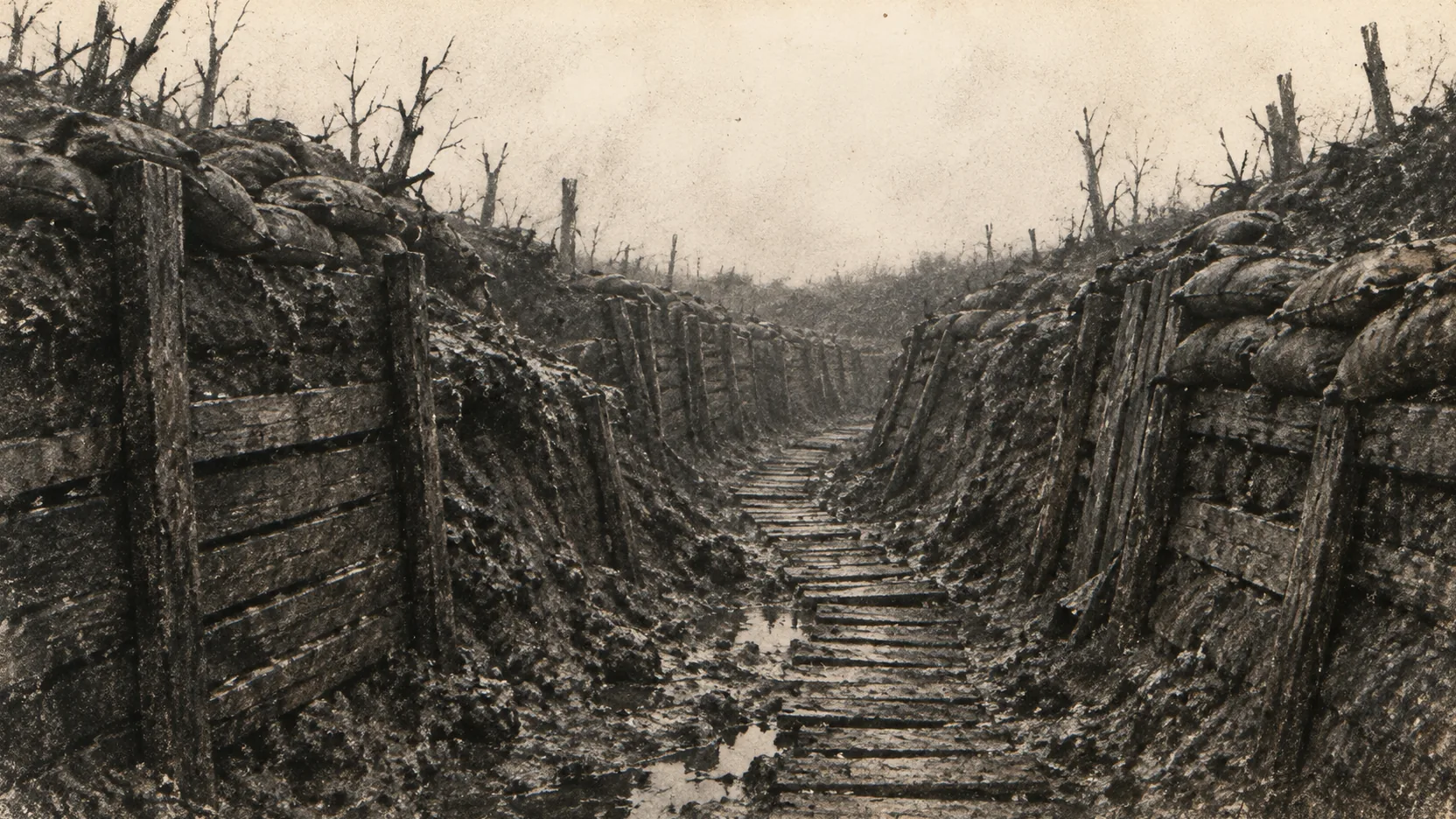
13.10.–20.11. Trench warfare in Artois at Angres and the Loretto Heights, among others
19.10.–30.10. Battle at Lille (assault on Lorgis and Richebourg l’Avoué)
30.11.–20.1. Trench warfare in French Flanders at Festubert
21.11.–06.12. Trench warfare in French Flanders at Fromelles
06.12.14–25.03.1916 Trench warfare in French Flanders at Pétillon
18 and 19.12.1914 December battle in French Flanders (fight at the water fortress)

The deployment of IR 13 at the front (Operations calendar 1915)
1915
10–14.03. Battle of Neuve-Chapelle
09–24.05. Battle at La Bassée
25.09. Autumn battle at La Bassée (near Neuve-Chapelle)

The deployment of IR 13 at the front (Operations calendar 1916)
07.06.–02.07. Trench warfare before Verdun on the Caurettes Heights
15.06. Fighting at Le Mort Homme (the "Dead Man")
13.07.–07.09. Trench warfare before Verdun on the Dead Man
– 22.09. Battle of the Somme (near Bouchavesnes)
01.10.–31.01.1917 Trench warfare before Verdun on Hill 304 (Hindenburg sector)
28.12. Stormtroop operation "Leifeld"


The deployment of IR 13 at the front (Operations calendar 1917)
– 29.01. Storming of the combat line of Hill 304
02.02.–12.04. Trench warfare before Verdun on Hill 304 ("Depth" sector)
18.02. and 19.02. Stormtroop operations "Leifeld"
13.04.–10.05. Trench warfare before Verdun in the Avocourt Wood, "Source" sector
01.06.–02.08. Trench warfare on the Chemin des Dames at Cerny
and 11.06. Fighting west of Cerny (operations "Hartholz and Biermann")
28.06.–07.07. Storming of the French trenches on the Bovelle ridge (operation "Westfalen")
31.07.–02.08. Storming of the heights line of the Chemin des Dames east of Cerny (operation "Blücher")
09.08.–21.09. Trench warfare in the Siegfried position at St. Gbain
– 25.10. Trench warfare on the Chemin des Dames at Chavignon
23.10. Battle at Chavignon
18.12.17–08.02.18 Trench warfare before Verdun in the Avocourt Wood (Forest sector)


The deployment of IR 13 at the front (Combat calendar 1918)
25.01. Assault-party operation "Urlaub"
21.03. - 06.04. Major battle in France
and 22.03. 3rd breakthrough at Ronssoy
27.03. - 06.04. Fighting on the Ancre at Morlancourt-Treux
07. - 10.04. Fighting on the Ancre at Dernancourt
19.04. - 16.05. Fighting on the Avre at Moreuil
01.07. - 07.08. Fighting between the Somme and the Roman Road at Hamel and Villers-Bretonneux
08. - 09.08. Tank battle between the Ancre and Avre
- 12.08. Battle at the Roman Road
- 27.08. Battle at Albert-Péronne (fighting north of the Somme)
29.09. - 11.11. Defensive battle in the Champagne, including the Meuse.


Records of a member of IR 13 about his wartime service from August 1914.
The deployment of IR 13 in the First World War is to be additionally documented using the original, meticulous records of a war volunteer from IR 13:
28.08.1914 Enlisted as a war volunteer into the Es. Batl. IR 13 Münster i. W.
17.10.1914 Appointed Gefreiter
09.10.1914 - 21.10.1914 Transport to France via Wanne, Cologne, Aachen, Liège, Ans, Tirlemont, Louvain, Brussels, Mons, Valenciennes, Cambrai to Douay. On 21.10. in the evening in the cavalry barracks in Douay.
22.10.1914 March to Angres (Loretto Heights) to IR 13; assigned to 8/13.
24.10.1914 Moved into the front-most position. Baptism of fire.
24.10.1914 - 10.11.1914 Trench fighting at Angres with rest days in Angres
11.11.1914 - 19.11.1914 Trench fighting at and in Carency (Loretto Heights). Relieved by IR 15.
20.11.1914 March to Fournes (near Lille)
24.11.1914 - 05.12.1914 Trench fighting at Fromelles with rest days there.
07.12.1914 - 04.01.1915 Trench fighting at Neuve-Chapelle with rest days in Fournes.
Including: 18 and 19.12.1914. Battle in French Flanders.
Christmas in the position.
31.12.1914 New Year’s Eve and Christmas celebration in Fournes.


Continuation of the records.
05.01.1915 - 10.02.1915 Ill in the dispensary and Field Hospital VII in Haubourdin (Lille).
11.02.1915 Back to 8/13.
12.02.1915 - 06.04.1915 Trench fighting at Neuve-Chapelle with rest days in Fournes.
Including: 10. - 14.03.1915 Battle of Neuve-Chapelle.
22.03.1915 Transferred to 11/13.

Continuation of the records.
07.04.1915 Around 2 a.m. on patrol, wounded by an infantry projectile.
Shot through the thigh and abdomen.
07.04.1915 - 17.04.1915 Field Hospital IV, Sainghin en Weppes.
02.09.1915 - 19.10.1915 Reserve Hospital Hagen i. W. General Hospital.
20.10.1915 - 09.12.1915 Association hospital Vollmarstein, Johanna-Helenenheim.
09.12.1915 - 17.04.1916 Reserve Hospital Hagen i. W. Eye clinic.

Continuation of the records.
18.04.1916 Departure from Münster to the field recruit depot of the 13th Infantry Division.
19.04.1916 - 09.06.1916 At the field recruit depot in Bourghelles (near Tournai).
10.06.1916 - 27.06.1916 At the field recruit depot in Breux (near Montmedy).
28.06.1916 Back to the 8th Company I.R. 13 (left bank of the Meuse), in the evening carrying food to the Rabenwald.
30.06. - 12.07.1916 Rest quarters in Liny (near Dun).
12.07.1916 - 07.09.1916 Trench fighting before Verdun. Toter-Mann, T-wood and Heckengrund; rest days in Brieulles.
07.08.1916 Promotion to non-commissioned officer and officer candidate.
11.09.1916 - 20.09.1916 Battle of the Somme. Position in front of Allaines (near Peronne).
25.09.1916 - 05.10.1916 Rest quarters in Milly (near Dun).
continued under 1917.


Continuation of the records.
05.10.1916 - 15.05.1917 Fighting before Verdun. Hill 304, Heckengrund, Forest of Malancourt.
19.10.1916 Inspection by the Crown Prince in Stenay.
01.11.1916 Transferred to the new 6/13.
01.11.1916 - 24.11.1916 Commanded to the M. W. detachment of the regiment.
06.12.1916 Assault on the Backenzahn (Hill 304).
10.12.1916 Award of the Iron Cross 2nd Class.
03.01.1917 - 04.02.1917 Commanded to the officer candidate course of the 13th Infantry Division in Cunel.
11.03.1917 - 25.03.1917 Home leave.
15.04.1917 Promotion to Vizefeldwebel.
17.05.1917 - 27.04.1917 Rest quarters in Gizy (before Laon). Readiness for the double battle Aisne-Champagne.
28.05.1917 - 02.08.1917 Fighting on the Chemin des Dames at Cerny (near Laon).
07.06.1917 Assault on enemy sap heads.
28.06.1917 - 03.07.1917 Storming of the trenches at Bouelle.
06.07.1917 - 09.07.1917 Repulsion of enemy attacks at Bovelle-Ferme.
31.07.1917 Assault in front of Cerny.
02.08.1917 Around 12 noon, as leader of an assault troop after storming enemy trenches, wounded by an artillery projectile—injuries to the head, left chest, left shoulder and left upper arm. Loss of the left eye.
02.08.1917 - 14.08.1917 Field Hospital 70 of the 13th Infantry Division Notre de Liesse.
15.08.1917 - 02.11.1917 Reserve Hospital IV, Bonn, surgical ward Brüderhaus.
31.08.1917 Promotion to Leutnant d. R. in IR 13.
04.11.1917 - 10.11.1917 Reserve Hospital III, Wiesbaden. Auxiliary hospital Hotel "Grüner Wald".
11.11.1917 - 18.12.1917 Reserve Hospital IV, Bonn, surgical ward Brüderhaus.
19.12.1917 As company commander to E. I.R. Münster, 5th Company.


Continuation of the records.
01.02.1918 - 05.02.1918 Assigned to the grenade launcher course in Sennelager.
05.02.1918 Transferred to the II. Landsturm IR 611. 8th Company in Walbeck (Dutch border).
01.03.1918 Transferred to 6/611 in Herongen-Niederdorf.
01.07.1918 - 06.07.1918 Assigned to the course for troop gas officers in Münster.
08.07.1918 - 09.07.1918 Deputy company commander 7/611 Straelen.
10.07.1918 - 16.07.1918 Deputy company commander 8/611 Walbeck.
17.07.1918 Assigned for training as adjutant to III/611 in Cleve.
01.09.1918 Appointed adjutant.
30.11.1918 Discharged from Army service to the District Command Hagen i. W.
Photos from the estate of a subaltern officer from IR 13.


Inspection of IR 13 in the field in 1916


Images from the everyday life of IR 13 and its replacement or other replacement units in the home garrison during the First World War


Losses of IR 13 in the First World War
By the end of November 1916, IR 13 counted 11,047 dead, missing and wounded soldiers (see list below). In total, 175 officers and 4,038 non-commissioned officers and enlisted men of this formation fell in the First World War.
Homecoming of IR 13
On 11.11.1918 the armistice was concluded. The First World War was over.
For the forthcoming march back the regiment was withdrawn from the front and concentrated in Lamouilly (a commune in the present-day arrondissement of Verdun in the département Meuse in the French region Grand Est).
From 16.11. the withdrawal began. .
On 23.11. German soil was entered and quarters were taken beyond the Rhine at Bingen, Johannisberg and Geisenheim.
From 07.12. the regiment was transported from Rüdesheim station toward the home garrison.
On 08.12. (noon) the entry into the city of Münster took place. On the Prinzipalmarkt the formation was greeted by the Lord Mayor.
Afterwards they marched into the Ägidiikaserne. There the last regimental commander before the war addressed the assembled regiment.
After that demobilization began and the reduction of the strength initially to peacetime strength. The machine-gun companies No. 1 and 3 and the trench mortar company were dissolved immediately.
The unit was completely disbanded on 01.10.1919.


Monuments of IR 13 in Münster
The war memorial for the fallen of the Infantry Regiment Herwarth von Bittenfeld (1st Westphalian) No. 13 is located on the Promenade at the bend toward the Aasee. The design goes back to the artist Heinrich Bäumer Sr. The initiators were veterans of the corresponding formation. The memorial committee was led by Colonel (ret.) Krome and First Lieutenant of the Reserve (ret.) Ekey. The foundation stone was already laid in 1923. By letter of 24.10.1923 the memorial was handed over to the city of Münster, only a few inscriptions were still missing. The then Lord Mayor (Dr. Sperlich) responded with a letter dated 28.11.1923.

On 03.05.1925 it was inaugurated as part of a so-called regimental roll call. On that Sunday - after memorial services in three churches - at 11 a.m. for the dedication the flag delegations of the veterans' and military associations assembled. Afterwards a concert took place on the then Neuplatz. After the participants' and guests' lunch in various venues of the city, on the aforementioned square from 14:30 the roll call, a pass in review and the march through the city to the Schützenhof for the reunion celebration followed.


The appearance of the war memorial is a pyramid standing on four spheres on a square base plate, very similar to an obelisk. It is crowned by an iron cross. As decorative elements there are two high reliefs, namely a lion ready to spring and a half-reclining man whose arm rests on a sword. There is also a steel helmet with a laurel wreath. Above the lion is the inscription: "Loyalty for loyalty"; furthermore the corresponding units are named. Inscriptions were later added for the fallen of the Second World War.


Recommended Articles

Heeressoziologie
Colonel General v. Einem
The person of Colonel General Karl Wilhelm Georg August Gottfried von Einem called von Rothmaler (* January 1, 1853 in Herzberg am Harz; † April 7, 1934 in Mülheim an der Ruhr) is particularly associated with the garrison Münster. He was not only, until 1895, commander of the Cuirassier Regiment von Driesen (Westphalian) No. 4 in Münster, but also Chief of the General Staff of the VII Army Corps (from 1896) and later Commanding General of the VII Army Corps (from 1909). In 1914 he was appointed Commander-in-Chief of the 3rd Army and in 1915 was finally promoted to Colonel General. In the period from 1903 to 1909 he had been War Minister. He was already close to the young Emperor Wilhelm II, who also always protected him. In the preliminary remarks to the personal notes of Colonel General v. Einem about his time as an army commander in the First World War, the editor describes his five-year period as Commanding General of the VII: Army Corps as “all in all the happiest time of his life” (Junius Alter/ Hrgb., Ein Armeeführer erlebt den Weltkrieg. Persönliche Aufzeichnungen des Generalobersten v. Einem, Leipzig 1938, p. 22). On 07.04.April 1934 at around 4 o'clock in the morning von Einem died at the age of 81 in his then place of residence Mühlheim an der Ruhr. His grave is located in the Zentralfriedhof, namely in the Protestant Field West I. The funeral was also attended by Oskar, the son of the emperor living in Dutch exile.

Heeressoziologie
On the military culture of remembrance in Münster after 1918
When the Münster regiments finally returned to their home garrisons in 1918 and 1919 and were almost completely disbanded, the German Reich sank into revolutionary turmoil. Against the backdrop of the Weimar Republic, the processing of the military defeat began — a defeat that allegedly had not occurred (the "stab-in-the-back legend"); the myth of the front-line soldier and a culture of remembrance and commemoration developed.

Heeressoziologie
The Early Period – from the Town's Formation to the Thirty Years' War
In the process of development.