
On the History of Military Photography and Its Significance as a Historical Source for Uniform Studies
The article is additionally illustrated with original contemporary — predominantly previously unpublished — military photographs of international soldier types.
The Beginnings of Photography up to the Photograph as a Mass Phenomenon
Images shape the perception of history far more than written words, especially since from the mid-19th century photography seemed to depict contemporary events objectively and thereby largely supplanted painting in this function.


The development of photography did not happen suddenly; the physical and chemical prerequisites were prepared over a long period. Precursors of later cameras were already known in the Middle Ages. With the camera obscura it was possible to reproduce images captured through a lens in mirror-reversed form. It was used especially by astronomers but also by artists. Around 1550 the lens was invented. The first lenses were used as spectacle lenses to correct nearsightedness and farsightedness and were later installed in the first optical instruments (telescopes and microscopes). With such lenses brighter and sharper images could be produced. In 1685 the invention of the reflector mirror followed. In the 17th century the laterna magica — a projection device — became widespread. The German physician Johann Heinrich Schulz also discovered the light sensitivity of silver salts. For a long time, however, suitable fixing agents were sought in vain.


Only from the mid-1830s did the Englishman William Henry Fox Talbot and the Frenchmen Joseph Nicéphore Niépce and Louis Jacques Mandé Daguerre finally develop pioneering photographic processes. The first photograph is said to have been made in 1826 by Joseph Nicéphore Niépce using the heliography process. The process of the Frenchman Louis Jacques Mandé Daguerre to develop iodized silver images with mercury vapors and fix them with a salt solution was presented in 1839 before the Paris Academy of Sciences. Soon studios of daguerreotypists opened in France and other countries. The Prussian royal house also took note of this new medium. King Frederick William III had the process demonstrated at Charlottenburg Palace; his successor, King Frederick William IV, even established a studio for the daguerreotypist Hermann Biow/Hamburg in the palace in 1847.
British Soldiers


William Henry Fox Talbot took a different path. He exposed silver chloride papers and thus produced a paper negative. It was copied or projected onto light-sensitive salted paper. These images were less sharp compared to daguerreotypes, but they marked the beginning of the negative-positive process and paper photography, which proved to be the future.

The road to usable photographs was, however, long: because of long exposure times moving subjects were excluded for a long time, and the sharpness and contrast of early images were inadequate. Color photography emerged only late. Already in 1842 — concerning the Hamburg fire — the earliest photographic reportage was created. The event was recorded by daguerreotypes by Hermann Biow and Carl Ferdinand Stelzner.
French Soldiers.


In the Crimean War (1854–56) and in the American Civil War (1861–65) war photographers acted for the first time; notable photographers included Roger Fenton and George N. Barnard Matthew Brady. In the 1870s the first moving series photographs were produced. Thanks to improved dry plates — developed by the British physician Richard Leach Maddox — photographers no longer had to carry a complete darkroom with them, which promoted travel photography. From 1880 the first photos appeared as illustrations in newspapers. After the mechanical copying process was invented, photo postcards became common toward the end of the 19th century (from 1893). Images of Emperor Wilhelm II in particular, or group photos of the imperial family, were very popular and were sometimes distributed in six-figure print runs.
Belgian, Dutch, Danish and Swedish Soldiers


Further perfection of cameras — for example through the invention of the focal-plane shutter by photographer Ottomar Anschütz in 1894 — now also allowed short-exposure shots. From the end of 1895 images also began to move publicly; in Berlin the Skladanowsky brothers showed variety scenes filmed with self-built cameras. The impression of moving pictures was created by two projectors operating alternately. Gradually the first cinemas opened, e.g. in 1903 in Berlin-Neukölln. In early cameras film transport was operated by a hand crank. Initially very popular especially among the lower classes, film — still immature in its early phase but rapidly improving technically — soon became respectable. At the time of the Crown Prince's wedding in 1905 the first film recordings from the imperial house are documented. Kaiser Wilhelm II had a screening room installed in the Berlin Palace and promoted the film industry.
Austrian Soldiers


As early as 1887 the process for producing celluloid film was patented. A central role was played by the American entrepreneur George Eastman (1854–1932), who, through clever marketing of his company, opened photography to the mass market. The famous Kodak No. 1 by designer Frank A. Brownell reached the market in 1888. The first Kodak cameras and roll film were intended to make photography accessible to amateurs as well. Portable and handy cameras were already widespread in World War I; photography became a mass phenomenon. Millions of photos preserved this conflict and its participants for posterity.
Italian, Spanish and Portuguese Soldiers


Greek and Turkish Soldiers


Russian Soldiers from the Tsarist Empire. Original cabinet photos. Around 1900.


Photography, which had already become established in the 1860s, was quickly understood by rulers as a reproducible means of self-presentation; in particular Wilhelm II used photography and film consciously for self-staging1. The Kaiser was frequently the client of studio photographers; it is said there were about 20 official court photographers.

In Wilhelmine Germany there were a total of four official maneuver photographers (e.g. Franz and Oscar Tellgmann/, Kühlewindt/Königsberg and Jacobi/Metz).
Among the best-known photographers were the aforementioned Tellgmann brothers. They belonged to a long-established family of photographers that began with the painter Ferdinand Tellgmann (1811–1897) already in 1841 in Mühlhausen/Thuringia2. Especially Franz (1853–1933) and Oscar Tellgmann (1857–1936) documented the resplendent military in parades and maneuvers in numerous photos that were very popular and widely distributed.

Wilhelm II literally bestowed — even while in Dutch exile — partially hand-colored photos with a personal or facsimile signature, graded according to the rank and status of the recipient. But not only princes and the nobility enthusiastically embraced the new medium and recorded dynastic and family history in photo albums; all other social strata sought to immortalize themselves in the medium, which was relatively inexpensive and more authentic compared to painting.

Whereas until the mid-19th century ownership of images was a privilege of the nobility and the upper bourgeoisie, the photograph now gained great popularity as a relatively inexpensive medium. The deeply rooted human desire for a personal likeness promoted portrait photography, which quickly became established alongside object photography. At least in every bourgeois or large farming family there existed a photo album covered with velvet or punched leather with a metal clasp, which was often opened with photos of the Kaiser or the imperial family.

The carte-de-visite portrait (visiting-card photo or carte-de-visite) originated in France. Its first mention dates from 28.10.1854. In the same year André Adolphe-Eugène Disdéri filed a patent for it in Paris. The small portraits had a standardized format of 5.5 × 9 cm and were mounted on thin card. They were therefore about the size of a visiting card and cost about two to four thalers. The relatively low price also resulted from the fact that several photos could now be accommodated on a single glass plate. Carte-de-visite portraits showed either a head portrait or a full-length image. Portraits of famous personalities in this format also became widely distributed. The carte-de-visite became a mass product.
Later, larger formats known as cabinet photos came into fashion. Both variants were largely superseded in the late 19th century by photo postcards and later by the small-format photos of 35mm cameras.
Depictions of warfare have always aroused great public interest — previously as woodcuts, lithographs, steel engravings, etc. — for example the Neuruppin picture sheets are well known. War artists accompanied troops to the front on all continents. Now the medium of photography — military photography — was added.
Military photography documents all aspects of soldierly life; war photography, as a more specific genre, records scenes of armed conflict.
The first military daguerreotypes come from the Mexican–American War (1846–48). They show American troops in the Mexican city of Saltillo. An early photograph of Scottish soldiers on the fortifications of Edinburgh is recorded from 1844. Photographers named are David Hill and Robert Adamson. Early military photographs were also taken in the Second Sikh War (1848–49) and the Second Burma War (1852–53) by an amateur photographer serving as a medical officer in the East India Company: John McCosh.
War photography developed above all in the Crimean War (1854–56) and the American Civil War (1861–65). In response to the critical reports of the Times war correspondent William Howard Russell, the British War Office in 1854 sent Roger Fenton (1819–69), co-founder of the Royal Photographic Society, as an official war photographer to the Crimean theater. In 1855 the photographer returned to Britain and his staged shots also found favor with Queen Victoria and Prince Albert. The photos were shown in exhibitions and eventually 160 images were published. The documentation of the Crimean War was continued by photographers James Robertson (1813–88) and Felice Beato (1833/34–1907/08). Both later photographed during the Sepoy Rebellion in India (1857) and the latter, together with Charles Wigman (1832–91), in the Second Opium War, e.g. during the occupation of Peking by British and American troops in 1860.
American Soldiers


The American Civil War (1861–65) was accompanied and documented by numerous correspondents who — supported by many illustrators — prepared the fighting on the various fronts for readers of weekly newspapers such as Harper's or the Illustrated Weekly.
Especially Mathew B. Brady (1823–96) — already an esteemed portrait photographer before the outbreak of war — preserved this bloody civil war for posterity in many photographs. With two darkroom wagons he accompanied Union troops; later he commissioned others to take photographs. Approximately 20 (22) fully equipped photographers (so-called operators) were to be found on all fronts. Later impoverished, Mathew B. Brady had to sell his archive of 5,721 glass plates to the U.S. War Department. They have been preserved there.
The American Civil War was the first historical event to be comprehensively recorded photographically. The full range of this comprehensive documentation becomes clear when viewing the approximately 2,000 photographs in the two voluminous volumes: Photographic History of the Civil War by William C. Davis and Bell I. Wiley (New York, 1981/82).

Scenes from the Wars of German Unification 1864, 1866, 1870/71 were also recorded photographically. But photos of combat actions were not possible and images of the fallen were not desired.


Military photography comprises official and private photos. Official photos come from professional court and military photographers.
In World War I there were proper war correspondents.
Official photos could also serve propagandistic purposes.

Photography also served military purposes: the camera became a weapon. Aviation initially had the primary task of reconnaissance; aerial photographs were to clarify enemy positions. In addition, countless private photographs of soldiers (and other contemporaries) were taken.
The photograph accompanied the soldier in peace and war in his official and private spaces: in the barracks, in the room, on the drill square, on the march, in quarters, on the training ground, at inspections and parades, but also in bivouac, in the trench, in the hospital, showing band concerts, award ceremonies, funerals, etc.

World War I was the first media war. It was captured in millions of photos which, alongside the countless field-post letters1, constitute an essential part of the culture of remembrance.
These are only now gradually being recognized as outstanding sources.
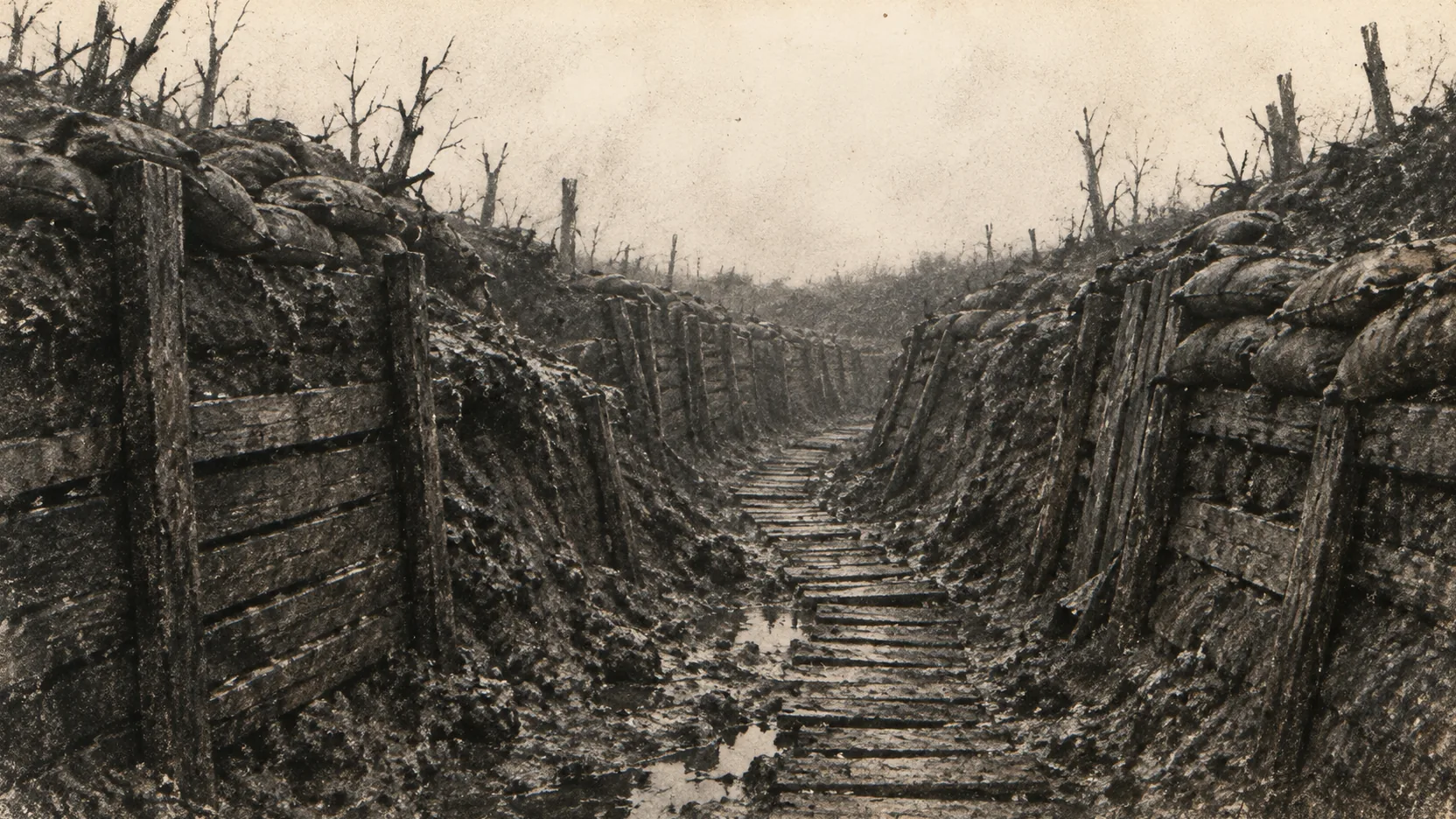
The appearance of this first truly world-encompassing armed conflict is, however, in the public consciousness shaped primarily by photos of the Western — less often the Eastern — Front. These widely known photographic motifs show heavily churned terrain with completely obliterated forests and entirely shattered villages, pitiful remnants of walls amid thousands of shell craters. They show positions fortified with sandbags above ground in the entirely waterlogged Flanders or whole areas covered with barbed wire with a system of deep trench lines and heavily developed defensive trenches. The extensive and complex trench system offered soldiers above all protection from the greatly increased effects of artillery. The positions in the West extended from the North Sea to Switzerland; entire national borders became fronts.

The daily reality of war resembled fortress warfare more and had little in common with the last German troop deployments in the Wars of Unification.

Until the end of the war, the belligerent parties tried in enormous material battles to break through and roll up the enemy main battle line; ultimately all offensives failed despite high densities of fire and mass assaults and did not justify the minor territorial shifts.


Numerous pictorial and other lavish volumes from the 1920s and 1930s shaped the still widespread visual image of World War I; exemplary here are only the work “Der Weltkrieg im Bild” with “original images of the War, Image and Film Office from the modern material battle” (Berlin–Oldenburg 1928) and the “Kriegsbilder-Werk with 600 pictures from all fronts after authentic, faithful photographic originals by the war photographer Hermann Rex, operator of the War, Image and Film Office in the service of the OHL from 1914–18”, the latter published in 1921 in its third edition under the title “Der Weltkrieg in seiner rauen Wirklichkeit” by Hermann Rutz (Oberammergau).

The Photograph as a Difficult — Historical — Source Type
With increasing dissemination, the photograph became a historical source for later generations, for it seeks to capture the ephemeral and conserve the present. It was and is appealing to the viewer to look into the faces of historical actors; for a moment history suddenly becomes real.

Photos are considered a difficult source type that brings unexpected problems. The photograph conveys a sense of reality. To this extent it is objective, because the camera records the light reflected from the surface of subjects. At the same time, the photo or the photographer always creates its own reality. The social status of the selected photographic subject, like the photographer himself, influences the photographic process. Therefore one must regularly ask whether the images are authentic or staged. Is the subject posing in front of the camera or is it a snapshot that faithfully depicts reality? The issue always concerns the identity of reality and its representation.

A photo can be historical evidence, but its informational value should never be accepted uncritically. Of interest is whether the photo comes from a professional photographer or from an amateur. Furthermore, the conditions under which the photo was produced are significant, e.g. in the studio, in the garrison, in the field, in the rear area, at the front, in the trench, in combat. The framing conditions for the photo’s creation are important for source criticism, especially when it comes to the sociological interpretation of preserved photos.

Moreover, the inevitable limitation of a photo's evidential value must be taken into account. The photo depicts a three-dimensional object in two dimensions. Through the lens only a segment of reality is captured, since the view through the camera lens does not correspond to the human field of vision. The photographer influences the photo by choice of framing and aperture or exposure time. It is thus the product of a conscious and an unconscious social and technical construction.

The photo is always created in a specific historical context. Contemporary aesthetics and fashion influence the choice of subject. The historical background that influences photography is inevitably subject to change.

Military Photography as a Source for Uniform Studies
While classical historiography often shows a certain fixation on textual sources and regards the handling of preserved photos at least as problematic, for military science and especially for uniform studies the historical photograph must be considered an outstanding source. Uniformology as a sub-discipline of military studies covers the cultural history of clothing, armament and equipment of armed forces over time. Whereas the uniform scholar studying military clothing and equipment of earlier times is dependent — besides surviving artifacts — on printed and unprinted regulations, files, reports and other pictorial sources such as eyewitness drawings or plate works by contemporary (and later) artists, the photograph serves for later periods as an excellent source of the soldier’s material culture.
Historical photos can reliably document how uniform and equipment items were worn and any deviations. The latter is especially relevant against the background of the insight that the mandatory specification of a particular adjustment by no means means that the corresponding orders were actually implemented in practice. Uniform history is shaped by autonomous actions, especially under the real conditions of a campaign. As Hans Kling notes: “One must always keep in mind: ‘Introduced’ does not necessarily mean that the troops actually wore it, especially during the course of the war (uniformity not possible due to raw material shortages). Thus, if one depicts a unit in 1915 with helmet and detachable spike, it may be correct for many individuals, but incorrect for the whole. In the Somme battle the infantry, with few exceptions, did not yet wear the steel helmet. In 1916 it came to the main battlefronts as a standard piece of equipment…”4.
Sources for the Chapter: The Beginnings of Photography up to the Photograph as a Mass Phenomenon
Willfried Baatz, Geschichte der Fotografie, Cologne 1997.
Jens Jäger, Photographie: Bilder der Neuzeit. Einführung in die Historische Bildforschung, Tübingen 2000.;
Timm Starl; Knipser. Die Bildgeschichte der privaten Fotografie, Munich/Berlin 1995.;
Ronald Berg, Die Photographie als alltagshistorische Quelle., in: Berliner Geschichtswerkstatt (ed.), Alltagskultur, Subjektivität und Geschichte. Zur Theorie und Praxis der Alltagsgeschichte, Münster 1994, pp. 187 ff.
PHOTOGRAPHS AS HISTORICAL SOURCES. On dealing with visual media in the historical sciences. http://bildwissen.hs-fhg.geschichte.uni-frankfurt.de/ueber-den-umgang-mit-fotografien.
Bernd Haunfelder, Münster und das Münsterland in frühen Photographien 1841 bis 1900, Münster 1988 (here: pp. 1–7).
Ildikó Kovács, The Significance of Photographs in the Archive. Master’s thesis. 2014.
Volker Jacob, Menschen im Silberspiegel. Die Anfänge der Fotografie in Westfalen, Greven 1989 (here: Introduction).
Jens Jäger, Fotografie und Geschichte, Frankfurt a. M. 2009.
Sources for the Chapter: The History and Typology of Military Photography
Artefakt Kulturkonzepte, War Photographs as Art, article on the website www.wissenschaft.de from 11.05.2015.
Büchl, War Photographs as a Historical Source, Diploma thesis 2009.
Rolf Hochhuth/Hans-Heinrich Koch, Kaisers Zeiten. Bilder einer Epoche. From the archive of court photographers Oscar and Gustav Tellgmann. Gütersloh 1977.
Rainer Fabian/Hans Christian Adam, Bilder vom Kriege. 130 Jahre Kriegsfotografie, Hamburg 1983.
Christian Frei: War Photographer (documentary film about James Nachtwey). 2003.
Judith Fritz, “The Visualization of War: Photography in the First World War,” article on the website www.habsburger.net.
Wilhelm Füßl, AERIAL PHOTOGRAPHY IN THE FIRST WORLD WAR, article on the website visual-history.de from 11.03.2014.
Anton Holzer, Armed with the Camera. War and Photography, Marburg 2003.
Anton Holzer, The Other Front. Photography and Propaganda in the First World War, Darmstadt 2007.
Martin Luksan: Photos from the Front. German War Photography in the Second World War. (First broadcast: 7 September 2009).
Wolfgang Michalka, The First World War. Effect and Perception, in: Bernd Hüppauf, War Photography, Munich 1994, pp. 876 ff.
Gerhard Paul, The History of Photographic War Reporting, article from 28.12.2005. Article on the website www.bpb.de.
Sources for the Chapter: The Photograph as a Difficult — Historical — Source Type
Michael Sauer, Photography as a Historical Source., in: Geschichte in Wissenschaft und Unterricht, 2002, pp. 570 ff.
Photographs as Historical Sources. Article on the website zeitenwende-lernportal.de from 02/2024.
PRIVATE PHOTO ALBUMS AS A HISTORICAL SOURCE, article on the website zeithistorische-forschungen.de from 2009.
Recommended Articles

Uniformierung & Ausrüstung
Martin Lezius, The Development of the German Army. Uniform Plates. 1936.

Uniformierung & Ausrüstung
The English Army and Navy Uniforms in War.
After the original published by Moritz Ruhl, Leipzig.

Uniformierung & Ausrüstung
French military dress and uniforms through the ages (up to 1850) in old lithographs.
Taken from an original plate volume, partly bound in leather, from the 19th century: Album des Costumes de l'Armée. No place or year.